
· Updated · 4 min read
4 Options for Your Old Workplace Retirement Savings
Leaving a job means deciding what to do with your retirement savings. Here are the four main choices — and what each one means for your taxes, growth, and future income.
Key takeaways
- You have four choices when leaving a job: keep money in the old plan, move it to a new employer's plan, roll it into an IRA, or cash it out.
- Keeping money in a tax-deferred account — any option except cashing out — lets your savings keep growing without paying taxes until withdrawal.
- Cashing out before age 59½ triggers income taxes plus a 10% early withdrawal penalty, which can sharply reduce what you actually receive.
- Required minimum distributions (RMDs) generally begin at age 73, or age 75 for those born on or after January 1, 1960.
- The best choice depends on your personal situation — compare fees, investment options, and plan rules before deciding.
- A financial professional can help you weigh the options and avoid costly mistakes.
Want to know which programs fit your situation? A free check shows what you may qualify for in about five minutes. No SSN.
Discover my benefitsWhy This Decision Matters
When you leave a job — whether you're retiring, changing careers, or stepping back — your workplace retirement savings don't just disappear. You have to decide what happens to that money.
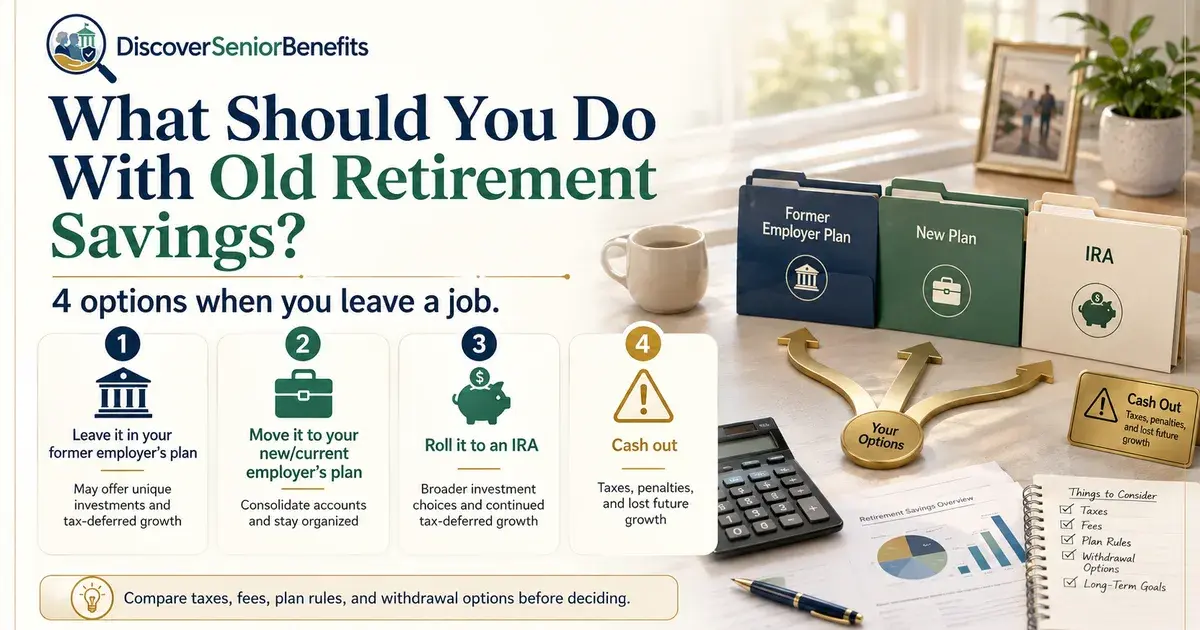
The four main options are:
- Leave the money in your former employer's plan
- Move it to a new or current employer's plan
- Roll it into an Individual Retirement Account (IRA)
- Cash it out
Three of those options keep your money growing tax-deferred, meaning you don't pay taxes on it until you withdraw it in retirement. The fourth — cashing out — can cost you significantly right away.
Option 1: Leave Money in Your Former Employer's Plan
Many employers let you keep your retirement savings in their plan even after you leave. This can be a simple choice if you're happy with the plan's investment options.
Benefits:
- Your money continues to grow tax-deferred.
- Federal law protects the funds from creditors.
- If you left the job at age 55 or older, you can make penalty-free withdrawals.
Things to watch:
- You cannot add more money to the plan.
- Some plans charge a fee to maintain your account.
- If your balance is $1,000 or less, the plan may automatically send you a check. Balances up to $7,000 may be rolled into an IRA on your behalf.
- After age 73 (or 75 if you were born on or after January 1, 1960), you must take required minimum distributions (RMDs) — a set amount you must withdraw each year from a traditional retirement account.
Option 2: Move Money to a New Employer's Plan
If your new employer offers a retirement plan and allows incoming rollovers, you can consolidate your old savings there. This keeps everything in one place.
Benefits:
- You can keep making tax-deferred contributions through your new job.
- Federal creditor protections apply.
- If you're still working past age 73, you may be able to delay RMDs.
- Penalty-free withdrawals are available if you leave that job at age 55 or older.
Things to watch:
- Investment choices in the new plan may differ from your old one.
- Fees and rules vary by plan — review them carefully before rolling over.
- If you're self-employed or run a small business, you may be able to move money into a self-employed 401(k), SEP IRA, or SIMPLE IRA.
Option 3: Roll Money Into an IRA
An IRA (Individual Retirement Account) is an account you open on your own through a bank or brokerage — not through an employer. Rolling your old workplace savings into an IRA is a popular choice.
Benefits:
- Your money keeps growing tax-deferred.
- IRAs often offer a wider range of investment options than employer plans.
- You may be able to make after-tax contributions that are tax-deductible.
Things to watch:
- After age 73 (or 75 if born on or after January 1, 1960), you must take annual RMDs from a traditional IRA — even if you're still working. Roth IRAs generally do not require RMDs.
- Penalty-free withdrawals before age 59½ are more limited than in an employer plan. In an employer plan, you can withdraw penalty-free at age 55 if you've left that job; with an IRA, you generally must wait until 59½.
- Federal creditor protections are stronger for workplace plans than for IRAs. State protections for IRAs vary.
- For 2026, the IRS contribution limit is $24,500 for workplace plans and $7,500 for IRAs. Income limits apply to tax-deductible IRA contributions.
Option 4: Cash Out Your Savings
Cashing out means withdrawing all or part of your retirement savings as a lump sum. This option comes with serious costs.
What it costs you:
- You owe federal and state income taxes on the full amount withdrawn.
- If you're under age 59½, you also pay a 10% early withdrawal penalty on top of income taxes. (This penalty does not apply if you left your job at age 55 or older.)
- You permanently lose the chance for that money to grow over time.
If you have an urgent need for cash and no other options, consider withdrawing only what you need — if your former employer's plan allows partial withdrawals — rather than taking the entire balance.
How to Choose the Right Option
There is no single right answer for everyone. The best choice depends on your personal situation, including:
- Fees: Compare what each plan or account charges.
- Investment options: Look at what's available in each account.
- Plan rules: Each employer plan has its own rules about withdrawals, rollovers, and distributions.
- Your age and timeline: RMD rules and penalty-free withdrawal ages differ depending on which option you choose.
If you're unsure, speaking with a financial professional can help you avoid costly mistakes. Always confirm details with the relevant plan administrator or financial institution before making a decision, as rules and limits can change.
See which of these programs you may qualify for. Free, no SSN, about five minutes.
Discover my benefitsNot legal or financial advice. The agency makes the final eligibility decision.
Related articles
4 min read
Caregiver Pay and Social Security Benefits for Families
Some states pay family members to care for a loved one at home, and Social Security has benefits for caregivers, spouses, and disabled adult children. Here is what to know before you apply.
5 min read
Step-Up in Cost Basis: What Heirs and Estate Planners Need to Know
When you inherit property, a tax rule called "step-up in basis" can wipe out years of capital gains — saving heirs thousands of dollars. Here's how it works and how to use it wisely in your estate plan.
4 min read
Long-Term Care: Options and How to Pay for It
Nearly 7 in 10 people turning 65 will need long-term care at some point. Understanding your payment options — from insurance to Medicaid — can protect your savings and ease the burden on your family.
Ask this article
Get answers about this article from the assistant on any paid plan.