· 5 min de lectura
IRA Required Minimum Distributions: A Simple Planning Target
Many retirees fear the required withdrawals from their IRA. A simple sticky-note formula shows whether that fear fits your situation, and which tax years matter most.
Puntos clave
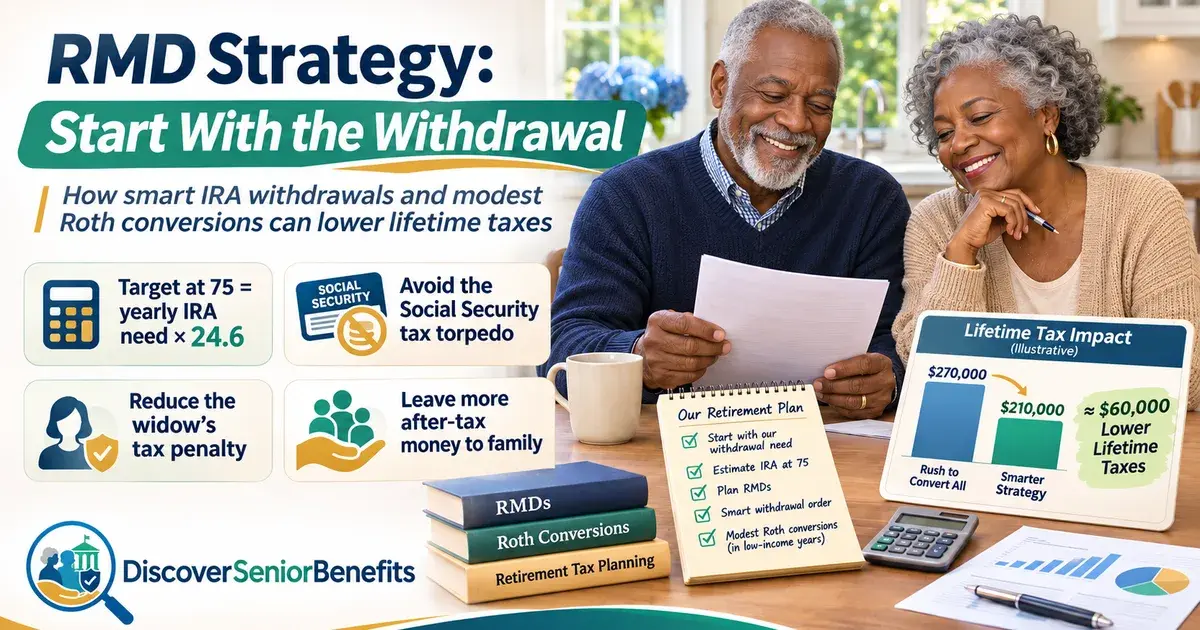
- A simple target: multiply what you need from your IRA each year by 24.6 to find the balance you want at age 75.
- If your projected balance lands under that target, early Roth conversions may cost you more than they save.
- A tax quirk can charge about 22% on income that sits in the 12% bracket once Social Security is taxed.
- A surviving spouse often pays more tax on less income, because single brackets are about half the married ones.
- The Medicare higher-income surcharge (IRMAA) is not a worry for many people with IRAs under about a million dollars.
- The years between work and required withdrawals are a planning window, and the plan should be rechecked every year.
¿Quiere saber qué programas se ajustan a su situación? Una verificación gratuita le muestra para qué podría calificar en unos cinco minutos. Sin número de Seguro Social.
Descubrir mis beneficiosThe one number most people never run
Retirement videos often say the same thing: convert to a Roth IRA as fast as you can before required withdrawals begin. A Roth IRA is an account where growth is tax-free and the IRS never forces money out while you are alive.
The video follows a sample couple, Steve (63) and Karen (61), with $900,000 in traditional IRAs. Their first forced withdrawal at age 75 is about $32,000. They need about $30,900 from that account that year. The so-called tax bomb is only about $1,100 of income they did not ask for.
The lesson: start with the withdrawal the IRS will demand, and work backward.
The sticky-note target
Here is the formula.
- Take what you will need from your IRA each year once Social Security starts.
- Multiply it by 24.6.
- That is the balance you want in the account the year you turn 75.
Steve and Karen spend about $86,000 a year, taxes included. Social Security covers $57,600, so the IRA must send $28,400. That times 24.6 is about $698,640, or roughly $700,000.
Other targets at age 75, using the same math:
- $20,000 a year needed: about $492,000
- $30,000 a year: about $738,000
- $40,000 a year: about $984,000
- $50,000 a year: about $1.23 million
If you were born between 1951 and 1959, required withdrawals start at 73 and the number is 26.5 instead. For anyone born in 1960 or later, they start at 75.
Why the number shrinks every birthday
A required minimum distribution (RMD) is not a penalty. For decades, the government let you skip tax on money put into a traditional IRA or 401(k). The RMD is the government collecting. Each year, divide your December 31 balance by the number next to your age on the IRS table.
That number gets smaller as you age. At 75 the IRS asks for about 4.1% of the balance. At 80 it is about 5%, at 85 about 6.25%, and at 90 more than 8%. The forced amount climbs while spending usually stays flat. Missing an RMD can cost a penalty of 25% of what you should have taken, or 10% if fixed within two years.
The video says to read your results this way:
- Under the target: no RMD problem. Paying tax early would protect against nothing.
- About one to one and a half times the target: a slow leak worth plugging while it is cheap. Steve and Karen are about 13% over.
- Two or three times the target: the scary videos are about you, and waiting makes the fix more costly.
The tax torpedo, Medicare surcharges, and the senior deduction
Social Security is taxed using "provisional income," which is your other income plus half your benefits. For married couples, benefits start becoming taxable above $32,000 and up to 85% can be taxed above $44,000. For singles, the lines are $25,000 and $34,000. These lines were set in 1983 and 1993 and never adjusted for inflation.
Because of this, one extra dollar from an IRA can pull 85 cents of Social Security into taxable income. That makes $1.85 of taxable income, which costs about 22% even though the couple sits in the 12% bracket. Planners call this the tax torpedo. It ends once 85% of benefits are already taxable.
Medicare surcharge (IRMAA). This is an extra Medicare premium for higher incomes. In 2026, the standard Part B premium is $22.90 a month. The first surcharge applies once a married couple's income passes $218,000, or $109,000 for a single person. It is a cliff, and Medicare looks at your tax return from two years earlier. Steve and Karen's highest income in any test is about $117,000, so they are nowhere near it. For many people with IRAs under a million dollars, the torpedo is the bigger issue.
Senior deduction. Since 2025, people over 65 get an extra $6,000 deduction each. It is scheduled to end after 2028, so the projections assume it is gone.
The widow's penalty and the kids' bill
When one spouse dies, the survivor keeps only the larger Social Security check. In the example, household Social Security drops from $57,600 to $37,200. Spending falls, but not by half. The IRA does not shrink at all, because Karen rolls Steve's IRA into her own.
The survivor usually files as single. Single brackets are about half the married ones, and the 22% bracket starts at $50,400 of taxable income. In the example, the couple paid about $4,433 in federal tax the year before Steve died. Karen, alone with less income, pays about $5,812. Less income, more tax.
Then the kids inherit. Since the SECURE Act, a child who inherits an IRA must empty it within 10 years. If the parent had already started RMDs, yearly withdrawals are also required along the way. That money stacks on the child's salary, often in their highest-earning years. At a 24% bracket, the $450,000 IRA in the example could cost the kids roughly $18,000 in federal tax.
Three levers to fix it
The years between retiring and the first RMD are a window. Tax brackets that go unused do not roll over. A married couple in 2026 has a $32,200 standard deduction and a 12% bracket that runs to $100,800 of taxable income.
Lever 1: flip the withdrawal order. Instead of spending the brokerage account first, Steve and Karen live off the IRA from 63 to 68. The ceiling in those years is health insurance. Karen buys marketplace coverage until Steve reaches Medicare, and the subsidy disappears above 400% of the poverty line, about $86,560 for a couple buying coverage for 2027. This lands them at about $690,000 at 75, almost exactly on target. Lifetime federal tax falls from about $162,571 to about $145,798.
Lever 2: small Roth conversions in empty years. From 69 to 74, they convert $25,000 a year, $150,000 in all. This costs roughly $815 to $1,130 in tax per year. They stop there because the next dollar would cost 18% to 22%. The first RMD drops to about $21,049.
Lever 3: qualified charitable distributions (QCDs). After age 70 and a half, you can send money from an IRA straight to charity. It counts toward your RMD and never shows up as income. The 2026 limit is $111,000 per person.
With all three, lifetime tax falls to about $115,099, roughly $47,000 less, and the family keeps about $81,000 more after tax.
Traps to avoid and how to use this
A few cautions:
- You can delay your first RMD until April 1 of the next year, but then you take two in one year. That is often a very costly tax year.
- With several IRAs, you can add up the RMDs and take the total from any one. 401(k) plans must each pay their own.
- Converted Roth money has its own five-year clocks. Check them before converting if you may need the money soon.
- Do not panic. Pulling big sums from an IRA at 74 and paying 22% or 24% to avoid a withdrawal that would be taxed at 12% can cost as much as doing nothing.
The results depend on assumptions: 4% growth above inflation, today's brackets, and a certain lifespan. Tax law can change. Recheck your balance against your target every fall.
For Medicare premium questions, a free Medicare counselor through your State Health Insurance Assistance Program (SHIP) can explain how income affects what you pay. Confirm details with the IRS, Medicare, or a tax professional, because this article is not tax or financial advice.
Programas en este artículo
Vea para cuáles de estos programas podría calificar. Gratis, sin número de Seguro Social, en unos cinco minutos.
Descubrir mis beneficiosBeneficios en su zona
Elija su estado para ver los programas que atienden a su condado.
Fuentes
Los datos de los programas en este artículo vienen de estas páginas oficiales, las mismas que citan las reglas de elegibilidad.
- State Health Insurance Assistance Program (SHIP) · acl.gov · Última verificación · 6 de noviembre de 2026
No es asesoría legal ni financiera. La agencia toma la decisión final sobre la elegibilidad.
Artículos relacionados
5 min de lectura
¿Puede Medicaid pagarle por cuidar a un familiar?
Muchos estados tienen programas de cuidado en el hogar de Medicaid que pueden pagarle a un familiar o amigo por brindar cuidado en casa. Aquí se explica cómo funcionan, quién puede calificar y qué deben tener en cuenta los cuidadores.
5 min de lectura
Penalidades del Seguro Social y Medicare: cómo evitarlas
Millones de estadounidenses pagan más de lo debido por penalidades de Seguro Social y Medicare que nunca vieron venir. Aquí se explica qué es cada penalidad, por qué ocurre y cómo protegerse.
4 min de lectura
Pago a Cuidadores Familiares y Beneficios del Seguro Social
Algunos estados pagan a familiares para cuidar a un ser querido en casa, y el Seguro Social tiene beneficios para cuidadores, cónyuges e hijos adultos discapacitados. Esto es lo que debe saber antes de solicitar.
Pregunte sobre este artículo
Obtenga respuestas sobre este artículo con el asistente en cualquier plan pagado.