· 4 min de lectura
Medicaid Work Rules in 2027: What Seniors and Families Should Know
New Medicaid work and renewal rules take effect in 2027. Here is who they may apply to, how exemptions work, and how to keep good records so coverage is not lost.
Puntos clave
- The new Medicaid work rules mainly affect adults ages 19 to 64 who do not have Medicare.
- Many states use other names for Medicaid, but the same rules may still apply.
- Medicaid has different levels, such as QMB, SLMB, and QI, so it helps to know which one you have.
- Exemptions may exist for medical frailty, certain caregivers, pregnancy, and American Indians and Alaska Natives, but each state sets its own details.
- Keep copies of every document, write down dates and hours, and respond to notices within the deadline.
¿Quiere saber qué programas se ajustan a su situación? Una verificación gratuita le muestra para qué podría calificar en unos cinco minutos. Sin número de Seguro Social.
Descubrir mis beneficiosWhy 2027 matters for Medicaid
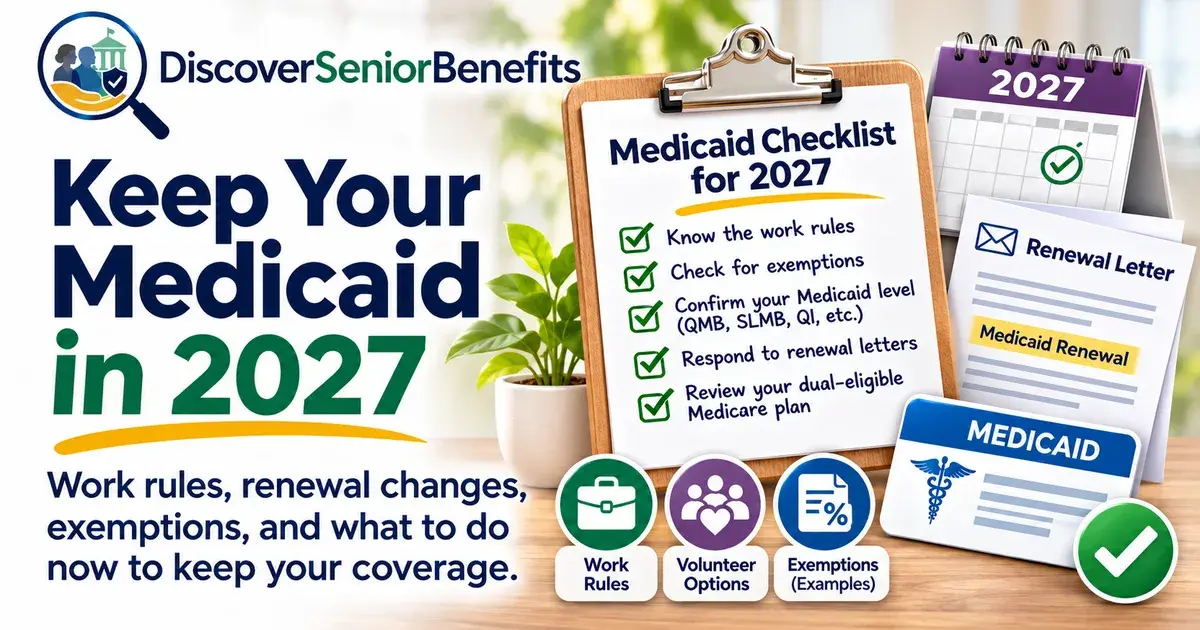
New laws and rules will change how some people keep Medicaid starting in 2027. Renewals and paperwork are getting harder, and some people could lose coverage if they miss a step.
Many states use a different name for Medicaid. If your state calls it something else, it is still Medicaid, and these rules may still apply to you. States are still deciding many details, so a local Medicaid office may not have every answer yet.
Who the work rule affects
The federal work rule is aimed at adults ages 19 to 64 who do not have Medicare. Most people in that group already work. Many just do not get health coverage through their jobs.
The rule may not apply to you if:
- You have Medicare, which means you are 65 or older or get Social Security disability benefits.
- You already have creditable health coverage from a spouse or from yourself.
Even then, states can still send renewal letters for other reasons, such as a change in income or an inheritance. Read every letter and respond to it.
Know your level of Medicaid
Medicaid has different levels. Examples include Qualified Medicare Beneficiary (QMB), Specified Low-Income Medicare Beneficiary (SLMB), Qualifying Individual (QI), and cost sharing. These are part of the Medicare Savings Programs, which can help pay Medicare costs.
The level you have affects what you pay, what coverage you get, and which dual eligible plan you can join.
A person with both Medicare and Medicaid is called dual eligible. Dual eligible people can often choose a special Medicare Advantage plan. The yearly plan review period starts October 15, so check that your plan still fits your needs. Free Medicare counseling through your state's SHIP can help with that review.
A simple first step is to call the Medicaid office and ask which level of Medicaid you have, then write down the answer.
If the state moves you to a lower level, you may not lose coverage, but your costs could go up. If the change looks wrong, contact the office and ask for the same coverage you had before.
Possible exemptions
Some people may not have to meet the work or volunteer rule. Possible exemptions include:
- Being medically frail, which means a health problem makes work hard.
- Being a certain parent or family caregiver. This is expected to be a gray area that states handle differently.
- Pregnancy and coverage after pregnancy, which have separate protections.
- Being an American Indian or Alaska Native.
States are handling proof differently. Two states, Nebraska and Montana, have said they will accept a person's own statement of medical frailty for now. Other states may ask for a doctor's note or medical records. Ask the Medicaid office exactly what proof is needed.
The state first checks records it already has, such as limited Social Security records. If those records are enough, nothing more may be needed. If not, the state will ask for documents. Write down who gave you any answer, the date, and what was said.
What counts as qualifying activity
People who are not exempt must show 80 hours of qualifying activity in a month. Each state will decide some of the details. Activities can include:
- Paid work or an eligible work program.
- Approved community service or volunteering.
- At least half-time enrollment in a qualifying education program.
- Earning enough monthly household income to meet the rule. The transcript mentions at least $580 a month, but the exact amount may vary by state.
Hours can be combined. For example, 50 hours of work plus 30 hours of approved volunteering adds up to 80 hours. Ask the state whether a specific volunteer role counts, who confirms the hours, and what proof is needed. For school, ask whether night classes, correspondence courses, or online programs qualify. Regular Medicaid income limits still apply.
Keep records and answer notices
Good records protect your coverage.
- Write down dates and actual hours worked or volunteered.
- Use whatever reporting system your state requires, but also keep personal records.
- Always make a copy of anything sent to the state. Papers can get lost.
- Ask which month the state is checking and what it can already confirm from records on file, such as wage reports.
- Ask about a temporary hardship option. Each state decides whether to offer it.
Three questions work well on every call: What is needed? By when? Where should it be sent?
If a non-compliance notice arrives, there are 30 calendar days to respond. Match the proof to the months named in the letter. A separate letter ending coverage can come later with its own deadlines. Every such letter should list appeal rights, so follow that deadline. During an appeal, ask whether coverage can continue while documents are gathered.
Being exempt from the work rule does not end renewals. Renewals still happen every 12 months, and for some people every 6 months. Confirm details with your state Medicaid agency, since the agency makes the final decision.
Programas en este artículo
Vea para cuáles de estos programas podría calificar. Gratis, sin número de Seguro Social, en unos cinco minutos.
Descubrir mis beneficiosBeneficios en su zona
Elija su estado para ver los programas que atienden a su condado.
Fuentes
Los datos de los programas en este artículo vienen de estas páginas oficiales, las mismas que citan las reglas de elegibilidad.
- Qualified Medicare Beneficiary (QMB) · medicare.gov · Última verificación · 17 de noviembre de 2026
- Specified Low-Income Medicare Beneficiary (SLMB) · medicare.gov · Última verificación · 17 de noviembre de 2026
- Qualifying Individual (QI) · medicare.gov · Última verificación · 17 de noviembre de 2026
- State Health Insurance Assistance Program (SHIP) · acl.gov · Última verificación · 17 de noviembre de 2026
No es asesoría legal ni financiera. La agencia toma la decisión final sobre la elegibilidad.
Artículos relacionados
5 min de lectura
Carta del Seguro Social 2027: qué línea importa según su año de nacimiento
Viene un aumento de 3.6% en 2027, pero la línea de su carta del Seguro Social que importa depende del año en que usted nació. Esto es lo que cada grupo de edad debe verificar antes de enero.
5 min de lectura
Penalidades del Seguro Social y Medicare: cómo evitarlas
Millones de estadounidenses pagan más de lo debido por penalidades de Seguro Social y Medicare que nunca vieron venir. Aquí se explica qué es cada penalidad, por qué ocurre y cómo protegerse.
4 min de lectura
Inscripción Abierta de Medicare 2026: Fechas Clave y Programas para Ahorrar
La Inscripción Abierta de Medicare va del 15 de octubre al 7 de diciembre de 2026. Esto es lo que debe hacer antes de la fecha límite, y dos programas que pueden reducir sus costos todo el año.
Pregunte sobre este artículo
Obtenga respuestas sobre este artículo con el asistente en cualquier plan pagado.