· 4 min read
Medicaid Work Rules in 2027: What Seniors and Families Should Know
New Medicaid work and renewal rules take effect in 2027. Here is who they may apply to, how exemptions work, and how to keep good records so coverage is not lost.
Key takeaways
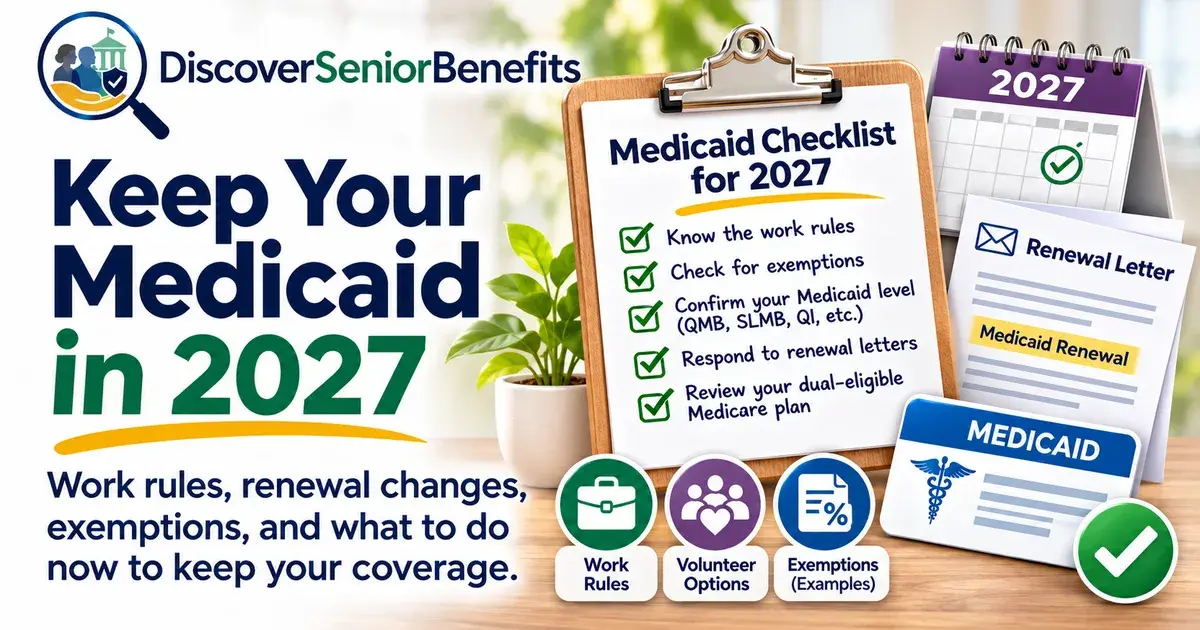
- The new Medicaid work rules mainly affect adults ages 19 to 64 who do not have Medicare.
- Many states use other names for Medicaid, but the same rules may still apply.
- Medicaid has different levels, such as QMB, SLMB, and QI, so it helps to know which one you have.
- Exemptions may exist for medical frailty, certain caregivers, pregnancy, and American Indians and Alaska Natives, but each state sets its own details.
- Keep copies of every document, write down dates and hours, and respond to notices within the deadline.
Want to know which programs fit your situation? A free check shows what you may qualify for in about five minutes. No SSN.
Discover my benefitsWhy 2027 matters for Medicaid
New laws and rules will change how some people keep Medicaid starting in 2027. Renewals and paperwork are getting harder, and some people could lose coverage if they miss a step.
Many states use a different name for Medicaid. If your state calls it something else, it is still Medicaid, and these rules may still apply to you. States are still deciding many details, so a local Medicaid office may not have every answer yet.
Who the work rule affects
The federal work rule is aimed at adults ages 19 to 64 who do not have Medicare. Most people in that group already work. Many just do not get health coverage through their jobs.
The rule may not apply to you if:
- You have Medicare, which means you are 65 or older or get Social Security disability benefits.
- You already have creditable health coverage from a spouse or from yourself.
Even then, states can still send renewal letters for other reasons, such as a change in income or an inheritance. Read every letter and respond to it.
Know your level of Medicaid
Medicaid has different levels. Examples include Qualified Medicare Beneficiary (QMB), Specified Low-Income Medicare Beneficiary (SLMB), Qualifying Individual (QI), and cost sharing. These are part of the Medicare Savings Programs, which can help pay Medicare costs.
The level you have affects what you pay, what coverage you get, and which dual eligible plan you can join.
A person with both Medicare and Medicaid is called dual eligible. Dual eligible people can often choose a special Medicare Advantage plan. The yearly plan review period starts October 15, so check that your plan still fits your needs. Free Medicare counseling through your state's SHIP can help with that review.
A simple first step is to call the Medicaid office and ask which level of Medicaid you have, then write down the answer.
If the state moves you to a lower level, you may not lose coverage, but your costs could go up. If the change looks wrong, contact the office and ask for the same coverage you had before.
Possible exemptions
Some people may not have to meet the work or volunteer rule. Possible exemptions include:
- Being medically frail, which means a health problem makes work hard.
- Being a certain parent or family caregiver. This is expected to be a gray area that states handle differently.
- Pregnancy and coverage after pregnancy, which have separate protections.
- Being an American Indian or Alaska Native.
States are handling proof differently. Two states, Nebraska and Montana, have said they will accept a person's own statement of medical frailty for now. Other states may ask for a doctor's note or medical records. Ask the Medicaid office exactly what proof is needed.
The state first checks records it already has, such as limited Social Security records. If those records are enough, nothing more may be needed. If not, the state will ask for documents. Write down who gave you any answer, the date, and what was said.
What counts as qualifying activity
People who are not exempt must show 80 hours of qualifying activity in a month. Each state will decide some of the details. Activities can include:
- Paid work or an eligible work program.
- Approved community service or volunteering.
- At least half-time enrollment in a qualifying education program.
- Earning enough monthly household income to meet the rule. The transcript mentions at least $580 a month, but the exact amount may vary by state.
Hours can be combined. For example, 50 hours of work plus 30 hours of approved volunteering adds up to 80 hours. Ask the state whether a specific volunteer role counts, who confirms the hours, and what proof is needed. For school, ask whether night classes, correspondence courses, or online programs qualify. Regular Medicaid income limits still apply.
Keep records and answer notices
Good records protect your coverage.
- Write down dates and actual hours worked or volunteered.
- Use whatever reporting system your state requires, but also keep personal records.
- Always make a copy of anything sent to the state. Papers can get lost.
- Ask which month the state is checking and what it can already confirm from records on file, such as wage reports.
- Ask about a temporary hardship option. Each state decides whether to offer it.
Three questions work well on every call: What is needed? By when? Where should it be sent?
If a non-compliance notice arrives, there are 30 calendar days to respond. Match the proof to the months named in the letter. A separate letter ending coverage can come later with its own deadlines. Every such letter should list appeal rights, so follow that deadline. During an appeal, ask whether coverage can continue while documents are gathered.
Being exempt from the work rule does not end renewals. Renewals still happen every 12 months, and for some people every 6 months. Confirm details with your state Medicaid agency, since the agency makes the final decision.
Programs in this article
See which of these programs you may qualify for. Free, no SSN, about five minutes.
Discover my benefitsBenefits in your area
Pick your state to see the programs that serve your county.
Sources
Program facts in this article trace to these official pages, the same ones the eligibility rules cite.
- Qualified Medicare Beneficiary (QMB) · medicare.gov · Last verified · November 17, 2026
- Specified Low-Income Medicare Beneficiary (SLMB) · medicare.gov · Last verified · November 17, 2026
- Qualifying Individual (QI) · medicare.gov · Last verified · November 17, 2026
- State Health Insurance Assistance Program (SHIP) · acl.gov · Last verified · November 17, 2026
Not legal or financial advice. The agency makes the final eligibility decision.
Related articles
5 min read
2027 Social Security Letter: Which Line Matters for Your Birth Year
A 3.6% raise is coming in 2027, but the line on your Social Security letter that matters depends on the year you were born. Here is what each age group should check before January.
5 min read
Social Security & Medicare Penalties: How to Avoid Them
Millions of Americans pay more than they should because of Social Security and Medicare penalties they never saw coming. Here is what each penalty is, why it happens, and how to protect yourself.
4 min read
Medicare Open Enrollment 2026: Key Dates & Cost-Saving Programs
Medicare Open Enrollment runs October 15 to December 7, 2026. Here is what to do before the deadline — and two programs that can cut costs year-round.
Ask this article
Get answers about this article from the assistant on any paid plan.