About the platform
How the eligibility check decides what you qualify for.
Every claim on this site is anchored in an official .gov source — and you can see which one on every program in your results.
Trust model
Two layers, with a strict line between them. AI never decides eligibility.
Most AI eligibility tools let a chatbot make the call about whether you qualify. That is how hallucinated programs and wrong income limits get into people's results. This system separates the two responsibilities completely.
DiscoverSeniorBenefits is a privately operated educational tool. It is not a government agency, an insurance broker, or a benefits decision-maker, and it is not affiliated with or endorsed by any government agency. The responsible agency or program administrator makes every final eligibility and approval decision.
Decided by rules · no AI
- 1
Your answers
Age, ZIP, income range, household size, and a few yes/no questions.
- 2
Rules check each program
Code compares your answers to each program's rules, copied by hand from its .gov page.
- 3
Your matches
Each match shows the rule that applied, the official source, and the date it was last verified.
Written by AI
Plain-English explanation
AI turns the legal wording into plain English. It cannot add a program, change a result, or invent a number.
Layer 1
Deterministic rule engine
Each program's eligibility logic is encoded as code, by hand, from its official source. The same profile run against the same rules always returns the same answer. No probabilistic reasoning, no model decisions, no surprises.
Layer 2
Plain-English narrator
Once Layer 1 has decided whether a profile qualifies, an AI model translates the legalese into plain English: what the program is, why this profile qualifies, what to do next. The model is constrained against fabricating program details.
Sources
Every program, sourced from .gov.
No third-party content aggregators. No AI-summarized rules. Each program in the directory links back to its official federal or state agency source page.
Federal sources
cms.gov, ssa.gov, va.gov, energyhelp.us, hhs.gov
State & county sources
Each covered state's official agencies — Medicaid, aging services, property-tax relief — down to county sources like Area Agencies on Aging. Alabama, Arizona, Arkansas, California, Colorado, Connecticut, Florida, Georgia, Illinois, Indiana, Kentucky, Louisiana, Maryland, Massachusetts, Michigan, Minnesota, Mississippi, Missouri, Nevada, New Jersey, New York, North Carolina, Ohio, Oklahoma, Oregon, Pennsylvania, South Carolina, Tennessee, Texas, Virginia, Washington, and Wisconsin today; more states are added as their rules are encoded and verified.
Verification cadence
Every program is re-checked against its source at least once per quarter. Each result shows a 'Last verified' date.
Documented methodology
Each program's rules are hand-coded from its official source and versioned in Git. Every result links back to the .gov page behind it, so any answer can be traced to its source.
Privacy
CCPA/CPRA compliant by design.
Operating from California means following the strictest U.S. consumer privacy law from day one. Data minimization is the default, not an afterthought.
Never asked for
- Social Security number
- Exact date of birth
- Specific medical diagnoses
- Exact dollar values of assets
Your rights
- Data never sold, shared, or rented
- Vault uploads encrypted, never read or shared
- Opt out of analytics anytime
- Privacy questions answered personally
- Operating under California's CCPA/CPRA
Covered today
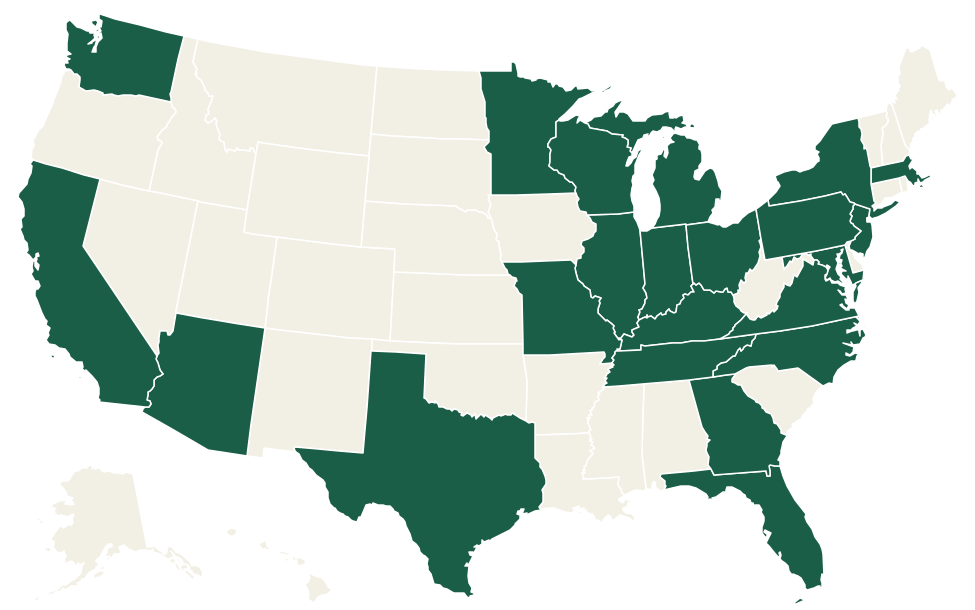
32 states, every county in each — 2,403 counties in all.
- Alabama67
- Arizona15
- Arkansas75
- California58
- Colorado64
- Connecticut8
- Florida67
- Georgia159
- Illinois102
- Indiana92
- Kentucky120
- Louisiana64
- Maryland24
- Massachusetts14
- Michigan83
- Minnesota87
- Mississippi82
- Missouri115
- Nevada17
- New Jersey21
- New York62
- North Carolina100
- Ohio88
- Oklahoma77
- Oregon36
- Pennsylvania67
- South Carolina46
- Tennessee95
- Texas254
- Virginia133
- Washington39
- Wisconsin72
Number = counties covered · Federal programs apply in every state
Coverage
Thirty-two states today. More soon.
Federal, state, and county programs are encoded and verified against official .gov sources before they go live — so every program in your results traces back to a source you can check.
Roadmap
Additional state coverage will roll out as program rules are encoded and verified. Sign up for updates from the newsletter to hear when a new state goes live.
Currently covered
12,101 programs covered today.
- Federal
- 26
- Alabama
- 273
- Arizona
- 77
- Arkansas
- 370
- California
- 403
- Colorado
- 299
- Connecticut
- 53
- Florida
- 418
- Georgia
- 657
- Illinois
- 563
- Indiana
- 499
- Kentucky
- 618
- Louisiana
- 269
- Maryland
- 113
- Massachusetts
- 78
- Michigan
- 418
- Minnesota
- 361
- Mississippi
- 404
- Missouri
- 540
- Nevada
- 72
- New Jersey
- 134
- New York
- 337
- North Carolina
- 494
- Ohio
- 567
- Oklahoma
- 278
- Oregon
- 176
- Pennsylvania
- 394
- South Carolina
- 200
- Tennessee
- 453
- Texas
- 1,365
- Virginia
- 677
- Washington
- 214
- Wisconsin
- 301
More are added as their eligibility rules are encoded and verified.
Questions, corrections, or coverage requests?
Spotted a rule that's out of date, or a program that should be covered? Every email is read.
A product of Discover Senior Benefits