
· Updated · 5 min read
The Hidden Medicare Cost That Can Follow a Roth Conversion
A common retirement tax strategy — converting a traditional IRA to a Roth — can quietly trigger higher Medicare premiums two years later. Here's what the standard advice leaves out, and how to protect yourself.
Key takeaways
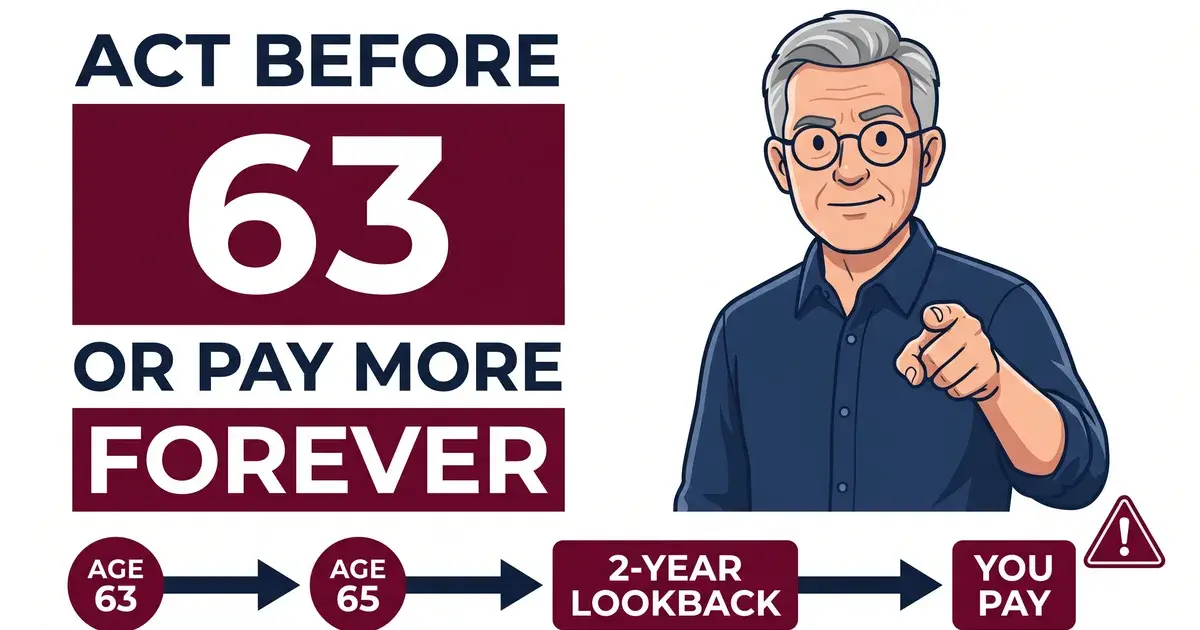
- Medicare Part B premiums are based on your income from two years ago — so what you earn at 63 directly affects what you pay at 65.
- Crossing an IRMAA income bracket by even one dollar can add hundreds of dollars per month to your Medicare premium.
- A large Roth conversion at 63 can simultaneously raise your taxes, eliminate your ACA marketplace subsidy, and push you into a higher Medicare bracket.
- Widowed spouses can face a sharp premium increase because single-filer IRMAA thresholds are much lower than married-filing-jointly thresholds.
- Form SSA-44 lets you ask Social Security to recalculate your Medicare premium based on current income after a major life event like retirement, job loss, or the death of a spouse.
- Before any large Roth conversion, calculate three numbers: taxes owed now, ACA subsidy lost, and future Medicare premium increase — then compare the total to the tax savings.
Want to know which programs fit your situation? A free check shows what you may qualify for in about five minutes. No SSN.
Discover my benefitsThe Two-Year Lookback Most People Never Hear About
When you enroll in Medicare Part B at 65, the Social Security Administration does not look at your current income. It looks at your tax return from two years earlier — specifically your Modified Adjusted Gross Income (MAGI). That number determines your monthly premium.
This rule is called IRMAA — Income Related Monthly Adjustment Amount. It has been part of the tax code since 2007, but most people only learn about it after the damage is done.
The brackets are not gradual. They are cliffs. Cross one income threshold by a single dollar and your entire premium jumps to the next level. For 2026, the Part B premium tiers for a single filer look like this:
- Up to $109,000: standard rate of $202.90/month
- $109,001–$137,000: $284.10/month
- $137,001–$171,000: $405.80/month
- $171,001–$205,000: $527.50/month
- $205,001–$499,999: $649.20/month
- $500,000 and above: $689.90/month
For married couples filing jointly, the thresholds are roughly double — but the cliff structure is the same.
The Medicare enrollment letter at 65 simply tells you what you owe. By then, the income decisions that caused it are already two years in the past.
Why Age 63 Is the Year That Matters Most
If you retire before 65 and buy health insurance through the ACA marketplace, you are managing three income-based systems at the same time:
- Federal income taxes — lower income means a lower bracket.
- ACA premium tax credits — your subsidy depends on your income relative to the federal poverty level. For a single person in 2026, keeping income in the $30,000–$60,000 range can mean roughly $600–$950 a month in premium credits. Push above 400% of the federal poverty line (around $60,000 for a single person) and those subsidies disappear entirely.
- IRMAA — whatever income you report at 63 is what Medicare uses when you turn 65.
A large Roth conversion at 63 hits all three at once. It raises your current-year taxes, wipes out your ACA subsidy, and locks you into a higher Medicare bracket for the next two years.
Consider a single 63-year-old with $30,000 in pension income who converts $150,000 from a traditional IRA. Their MAGI reaches $180,000. That means losing roughly $12,000 a year in ACA subsidies right now, and paying about $295 more per month for Medicare Part B starting at 65 — adding more than $4,200 a year. Combined, that is over $16,000 a year in real costs from one decision, most of it invisible until it was already made.
The Widow Penalty: When Doing Everything Right Still Costs More
There is a version of this problem that hits people who planned carefully. Consider a married couple with a combined income of around $140,000 — pension, wages, and dividends. Filing jointly, they stay comfortably inside the first IRMAA bracket at 65 and each pay the standard Part B premium.
Now imagine one spouse dies. The surviving spouse's income barely changes — maybe it drops slightly to around $140,000. But now they file as a single person instead of married filing jointly.
For married filers in 2026, the first IRMAA threshold is $218,000. For single filers, it is $109,000. At $140,000 as a single filer, the surviving spouse lands in the third bracket — $405.80 a month instead of $202.90. The premium doubles. The income barely changed.
This is sometimes called the widow penalty. It is not an error in the system. It is how the brackets are structured. Single filers face lower thresholds than married filers at every level.
If you are part of a couple and thinking through IRMAA, run the numbers for both scenarios — filing jointly and filing alone. The gap between those two answers can be significant, and knowing it ahead of time gives you options.
Form SSA-44: The Legal Right to Request a Recalculation
If your income drops significantly because of a major life event, you have the legal right to ask Social Security to recalculate your IRMAA based on your current income rather than your income from two years ago.
The form is called SSA-44 — Medicare Income Related Monthly Adjustment Amount, Life-Changing Event. It is available from the Social Security Administration and covers seven specific situations:
- Marriage
- Divorce or annulment
- Death of a spouse
- Work stoppage
- Significant reduction in work hours
- Loss of income-producing property due to disaster or disease
- Loss or reduction of pension income
This is not a workaround. It is written into the Social Security Act. The right has existed since 2007.
For example, a widow whose MAGI drops from $140,000 to around $70,000 after losing a spouse's pension could file SSA-44, list the death of a spouse as the life-changing event, and provide current estimated income. If approved, the Part B premium could drop from $405.80 a month back to the standard rate — saving more than $2,400 a year.
The review process typically takes 30 to 60 days. If Social Security denies the request, there is a formal right to appeal to the Office of Medicare Hearings and Appeals. If you have recently retired, lost income, or lost a spouse and your IRMAA notice does not reflect your current financial situation, find form SSA-44 before paying the higher amount. Always confirm the process and your eligibility directly with the Social Security Administration.
Two Paths: Aggressive vs. Measured Roth Conversion
For someone at 62 with a large traditional IRA who is on ACA marketplace coverage, the difference between an aggressive and a measured conversion strategy can be substantial.
Path A — Convert $150,000 a year for three years:
- At that income level, the ACA subsidy is lost — roughly $11,400 a year across three years, totaling about $34,200.
- Since conversions happen near age 63, Medicare Part B costs jump at 65, adding about $4,200 a year going forward.
- Short-term total impact: close to $38,400.
Path B — Convert $40,000 a year and keep MAGI around $60,000:
- Most of the ACA subsidy is preserved.
- Income stays below the first IRMAA threshold.
- The Roth balance grows more slowly, but without the $38,400 cost.
Path A is not wrong in every situation. If pension income already pushes MAGI above the ACA threshold regardless of conversions, or if a spouse's employer plan covers health insurance, the math shifts. Every situation is different. But for someone retired before 65 and relying on the marketplace, a large conversion at 63 is often the most expensive form of tax planning available.
A Simple Three-Number Check Before Any Conversion
Before finalizing any large Roth conversion, write down three numbers:
- How much tax do you pay this year if you do this?
- How much ACA subsidy do you lose?
- How much more will you pay for Medicare Part B two years from now?
Add them together. Then compare that total to your honest estimate of how much future tax you are actually saving by moving the money into Roth. If the short-term cost exceeds the long-term benefit, the conversion does not make sense. If the benefit is larger, it may. But the decision should be made with both sides visible.
Also watch for unplanned income events in the year you turn 63 — a home sale where gains exceed the exclusion amount, selling inherited assets, or a large IRA withdrawal to cover an unexpected expense. All of these count toward MAGI. If a large transaction can be moved to age 62 or 64 instead, that one-year shift can protect your Medicare bracket without otherwise changing the financial outcome.
If the timing is outside your control and the income is genuinely nonrecurring, document it carefully. Form SSA-44 may apply when the Medicare notice arrives two years later.
The core principle: do not let a tax decision destroy a health benefit. The income you report at 63 does two things at once — it determines your ACA subsidy this year and your Medicare premium in two years. Understanding which years carry the most weight is the first step to navigating them wisely.
Programs in this article
See which of these programs you may qualify for. Free, no SSN, about five minutes.
Discover my benefitsSources
Program facts in this article trace to these official pages, the same ones the eligibility rules cite.
- Qualified Medicare Beneficiary (QMB) · medicare.gov · Last verified · October 17, 2026
- Specified Low-Income Medicare Beneficiary (SLMB) · medicare.gov · Last verified · October 17, 2026
- Qualifying Individual (QI) · medicare.gov · Last verified · October 17, 2026
- State Health Insurance Assistance Program (SHIP) · acl.gov · Last verified · October 17, 2026
Not legal or financial advice. The agency makes the final eligibility decision.
Related articles
4 min read
Medicare Open Enrollment 2026: Key Dates & Cost-Saving Programs
Medicare Open Enrollment runs October 15 to December 7, 2026. Here is what to do before the deadline — and two programs that can cut costs year-round.
5 min read
4 Retirement Health Care Decisions to Get Right
Missing a health coverage enrollment window in retirement can mean higher costs that last for years. Here are the four decisions that matter most — and how to approach each one.
5 min read
4 Retirement Tax Surprises and How to Manage Them
Retirement taxes can be more complicated — and more costly — than many people expect. Here are four common tax surprises retirees face, plus strategies to help reduce the impact.
Ask this article
Get answers about this article from the assistant on any paid plan.