
· Updated · 4 min read
How Medicaid Pays for Long-Term Care (Medicare Does Not)
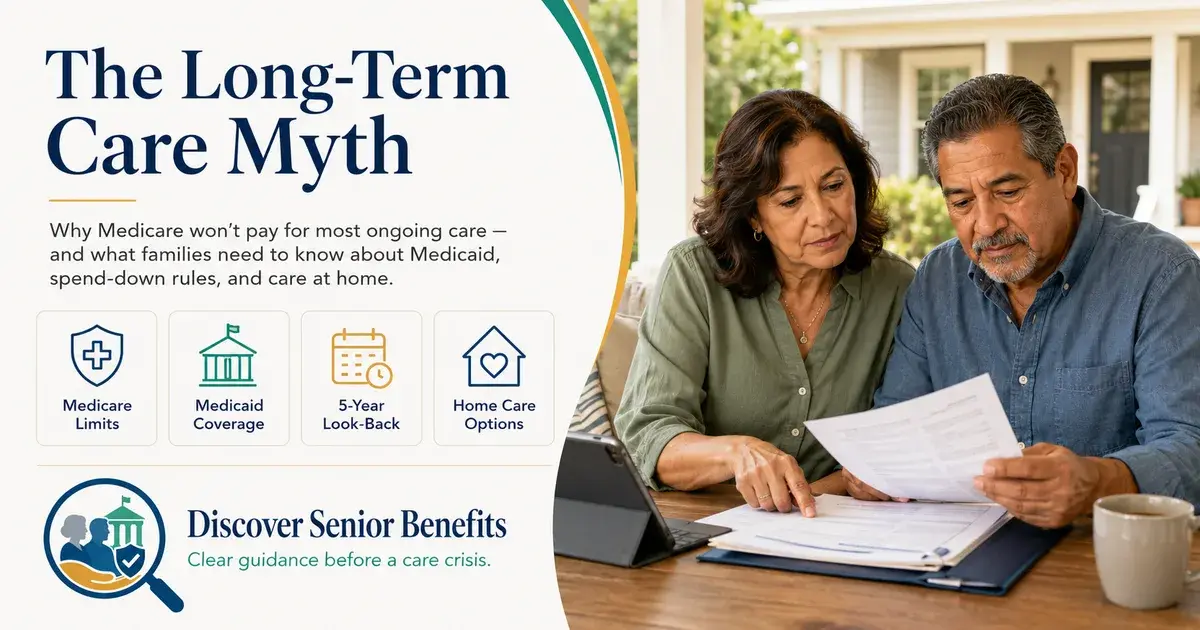
Most families assume Medicare covers nursing homes and ongoing home care. It does not. Here is how long-term care is actually paid for — and what families need to know before a crisis hits.
Key takeaways
- Medicare covers short-term recovery care only — it does not pay for ongoing help with bathing, dressing, or daily activities.
- Medicaid is the program that covers long-term care, both in nursing homes and, increasingly, at home.
- To qualify for Medicaid long-term care, a person must pass both a care test and a strict financial test.
- The five-year look-back means giving away money or property to qualify faster can trigger a penalty period.
- Married couples have special protections — the spouse who stays home can keep the house, a car, income, and a protected share of savings.
- Estate recovery rules mean the state may seek repayment from a person's estate after death, most often from the home.
The Most Expensive Misunderstanding in Retirement
Most families believe Medicare will pay for long-term care. It will not.
This misunderstanding is often discovered at the worst possible moment — after a fall, a stroke, or a dementia diagnosis, when a parent suddenly needs daily help and the bills start arriving. Understanding how long-term care is actually paid for, before a crisis, is one of the most valuable things a family can do.
What Medicare Actually Covers
Medicare is health insurance. It pays for doctors, hospitals, and short-term recovery. After a qualifying hospital stay, Medicare will cover a limited stay in a skilled nursing facility — up to 100 days, and only while the person is actively getting better.
What Medicare does not cover is custodial long-term care: the ongoing help with bathing, dressing, eating, using the bathroom, and managing medications that a frail older adult may need for months or years. That kind of care — whether in a nursing home or at home — is not a Medicare benefit. Private health insurance and Medicare Advantage plans do not cover it either.
What Long-Term Care Costs
Long-term care is expensive enough to drain a lifetime of savings.
- A year in a nursing home commonly costs more than $100,000.
- Around-the-clock care at home can cost just as much.
- Even part-time help several days a week adds up to thousands of dollars a month.
A small number of families have private long-term care insurance, but most do not. That is why, for the majority of older adults who need ongoing care, the program that ends up paying is Medicaid.
How Medicaid Long-Term Care Works
Medicaid is the joint federal and state program that does cover long-term care — both in nursing homes and, increasingly, in a person's own home. Qualifying involves two separate tests.
The care test. A nurse or assessor confirms that the person needs a "nursing-facility level of care" — meaning they need substantial hands-on help with everyday activities, or close supervision because of memory loss. This is a medical judgment.
The financial test. Medicaid long-term care is for people with limited income and assets. In most states, a single person can keep only about $2,000 in countable assets to qualify, though the primary home and one vehicle usually do not count. Income rules are different for long-term care than for regular Medicaid. The exact limits vary by state and change every year. Always confirm current limits with your state's Medicaid agency.
Spend-Down and the Five-Year Look-Back
Because the asset limit is so low, many people "spend down" — they pay for care or other needs until their countable savings fall under the limit.
Families must be careful about giving money or property away to qualify faster. When someone applies for Medicaid long-term care, the state reviews the previous five years of financial records. This is called the look-back period. Gifts or transfers made for less than fair value during those five years can trigger a penalty — a stretch of time when Medicaid will not pay, even though the money is already gone.
Moving assets around without professional guidance can backfire badly. This is one area where an elder-law attorney is worth the cost.
Protection for Married Couples
A common fear is that one spouse needing a nursing home will leave the other with nothing. Federal law specifically prevents this through spousal impoverishment protections.
The spouse who stays home — called the community spouse — does not have to spend down to $2,000. That spouse generally keeps:
- The house
- A car
- A monthly income allowance
- A protected share of the couple's savings
The state Medicaid agency calculates the exact protected amount each year. Married couples should never assume they are over the asset limit without checking, because the single-person numbers do not apply to them.
Care at Home, Not Just in a Nursing Home
Many families assume Medicaid long-term care means a nursing home. That has changed. Most states now run programs that pay for care in a person's own home and community instead — home health aides, personal care, adult day programs, home-delivered meals, home modifications, and care coordination.
These programs go by different names in different states, such as home- and community-based waivers, managed long-term services and supports, or PACE (the Program of All-Inclusive Care for the Elderly). The financial rules are similar to nursing-home Medicaid, but the care happens at home. For families who want to keep a parent in familiar surroundings, these in-home programs are often the most important benefit they have never heard of.
Estate Recovery and Next Steps
After a person who received Medicaid long-term care passes away, the state is generally required to try to recover what it spent — usually from the person's estate, most often the home. There are protections that delay or prevent recovery in certain situations, such as when a surviving spouse or a disabled child still lives in the home. Estate recovery is not a reason to avoid getting needed care, but it is a reason to plan early and ask questions.
Key reminders:
- Medicare will not pay for ongoing long-term care — do not count on it.
- Medicaid will, but it has a care test and a strict, state-specific financial test.
- The five-year look-back means transfers should not be made without advice.
- Married couples are far better protected than the single-person asset limit suggests.
- In most states, care can now be delivered at home, not just in a nursing facility.
Two good places to start are the local Area Agency on Aging and an elder-law attorney for anything involving the look-back or asset transfers. Always confirm program details with the responsible agency, as rules vary by state and change over time.
Programs in this article
See which of these programs you may qualify for. Free, no SSN, about five minutes.
Find my benefitsSources
Program facts in this article trace to these official pages, the same ones the eligibility rules cite.
- PACE — Program of All-Inclusive Care for the Elderly · medicaid.gov · Last verified · September 23, 2026
- Home-Delivered Meals (Meals on Wheels) · acl.gov · Last verified · September 23, 2026
- Older Americans Act Supportive Services (Title III-B) · acl.gov · Last verified · September 23, 2026
- State Health Insurance Assistance Program (SHIP) · acl.gov · Last verified · September 23, 2026
Not legal or financial advice. The agency makes the final eligibility decision.
Related articles
4 min read
What Is an Area Agency on Aging — and How Can It Help?
Every county in the U.S. has a public agency dedicated to helping older adults stay home and connected to their communities. Most families don't know it exists until they desperately need it.
5 min read
4 Retirement Health Care Decisions to Get Right
Missing a health coverage enrollment window in retirement can mean higher costs that last for years. Here are the four decisions that matter most — and how to approach each one.
5 min read
4 Retirement Tax Surprises and How to Manage Them
Retirement taxes can be more complicated — and more costly — than many people expect. Here are four common tax surprises retirees face, plus strategies to help reduce the impact.
Ask this article
Get answers about this article from the assistant on any paid plan.