
· Updated · 4 min read
Moving a Parent to a New California County: What Happens to Their Benefits
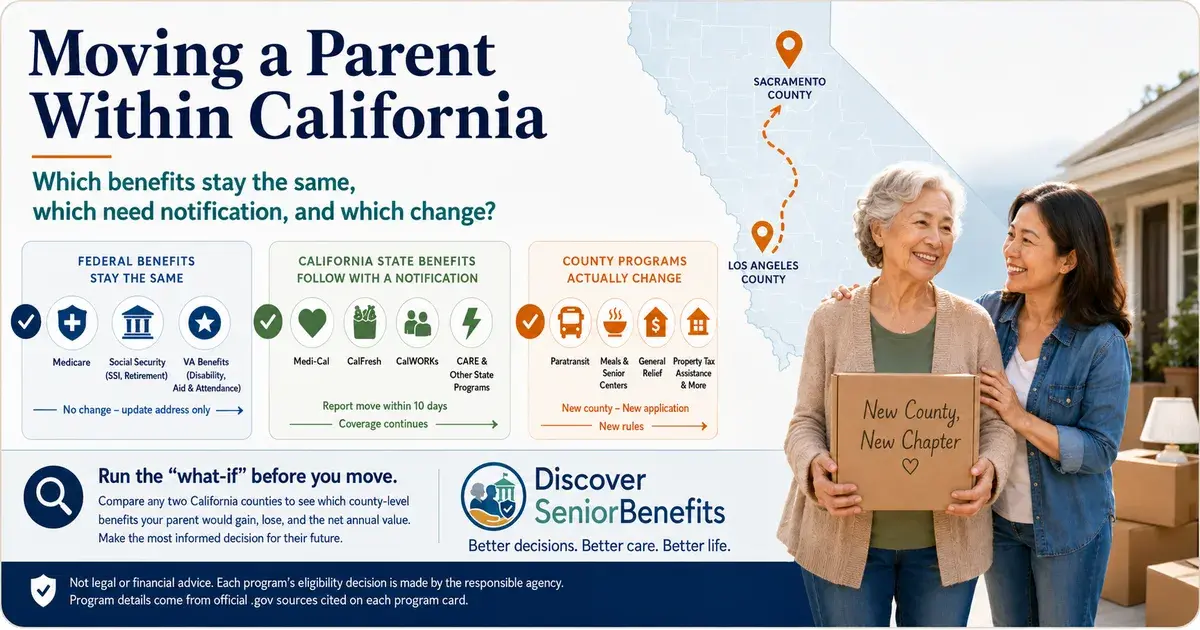
When an aging parent relocates to a different California county, some benefits follow automatically, some need a quick notification, and a few require a brand-new application. Here is what caregivers need to know before — and right after — the move.
Key takeaways
- Federal benefits like Medicare, SSI, and VA payments keep working after a county move — just update your address with each agency.
- Medi-Cal and CalFresh follow the senior across county lines, but the move must be reported to the original county within ten days.
- Medicare Advantage and Part D plans are sold by county — a move opens a Special Enrollment Period to switch plans.
- County programs like General Relief and paratransit do not transfer; the senior must apply fresh in the new county.
- Area Agency on Aging services — including home-delivered meals and caregiver support — are county-specific and require re-enrollment.
- Before choosing a destination county, compare the full set of county-level benefits to find the best fit for the parent's needs.
Want to know which programs fit your situation? A free check shows what you may qualify for in about five minutes. No SSN.
Discover my benefitsThe Simple Rule: Federal, State, and County Benefits Behave Differently
When a senior moves from one California county to another, the impact on their benefits depends entirely on which level of government runs the program.
- Federal programs do not care which county the senior lives in. They keep paying.
- California state programs follow the senior, but need an address update.
- County programs are the ones that actually change — and where caregivers need to do new research.
Knowing this distinction upfront prevents coverage gaps during an already stressful move.
Federal Benefits That Stay the Same
Medicare works anywhere in the United States. Moving from Los Angeles County to Sacramento County does not require a new Medicare card, a renewal, or re-enrollment. Original Medicare claims are paid regardless of the new address. The one useful step is updating the address with the Social Security Administration — by phone, online, or in person at any Social Security office — so future Medicare correspondence arrives at the right place.
Medicare Advantage and Part D plans are a different story. Both are sold by county. An HMO or PPO sold in one county usually does not cover providers in another. A Part D drug plan sold in one region may not be available in the next. A county move opens a Special Enrollment Period — typically two months around the move — to switch to a plan available in the new county. Missing that window means waiting until the next annual enrollment period (October 15 through December 7).
Supplemental Security Income (SSI), Social Security retirement, VA disability, and VA Aid and Attendance all keep paying after a move. Update the address with each agency. None require a new application.
California State Benefits That Follow With a Notification
Medi-Cal follows the senior across county lines, but the move must be reported to the original county within ten days. The new county then takes over the case, and coverage does not pause during the transfer. One thing to watch: not every Medi-Cal Managed Care Plan operates in every county. A plan that only covers one county will need to be switched when the senior arrives in the new county — the county handles that transition.
CalFresh works the same way. Report the move within ten days, and the new county absorbs the case. The monthly benefit amount does not change based on county.
California LifeLine (phone discount), CARE (energy assistance), and the Medicare Savings Programs all follow with a notification. None require a new application unless the move is accompanied by a significant income change.
Always confirm the notification process directly with the relevant agency, as rules can change.
County Programs That Actually Change
This is where relocation has real impact.
General Assistance / General Relief is run county by county. Benefit amounts vary across counties, and some smaller rural counties run loan-based programs with different rules entirely. A senior receiving General Relief in one county must apply fresh in the new county. The old benefit stops the month of the move.
Paratransit — door-to-door rides for seniors who cannot use fixed-route public transit — is also county-run. An ADA paratransit certification from one county is not honored by another county's transit system. The senior must apply for paratransit in the new county, which may include a functional assessment ride before approval. The process can take several weeks, so starting early matters.
Area Agency on Aging (AAA) services — including home-delivered meals, congregate meals, senior transportation, family caregiver support, and in-home personal care — are delivered through the local AAA, not a central state office. Waitlists, eligibility cutoffs, and even the program menus differ by county. A parent receiving home-delivered meals through one county's AAA will need to re-enroll through the new county's agency.
County property-tax assistance — including Property Tax Postponement and county-specific senior exemptions — can sometimes be transferred or claimed after a move, but the rules are detailed. A call to the new county's Assessor's office is the most reliable way to sort this out.
The Question Worth Asking Before the Move
For a caregiver weighing two California counties, the right question is not just "is this county cheaper to live in?" It is: "What specific benefits change, and is the new county's set net better or worse for this parent?"
A county with stronger General Relief, broader paratransit coverage, a well-funded Area Agency on Aging, and a county-specific property-tax exemption can meaningfully offset a higher cost of living. A county with thinner senior services can quietly cost more in unreimbursed care.
Running this comparison before signing a lease — rather than after — gives the family time to plan for any gaps and apply for new programs right away.
A Quick Checklist for the Move
- Update the address with the Social Security Administration.
- Update the address with the VA (if applicable).
- Report the move to the original county's Medi-Cal and CalFresh offices within ten days.
- Check whether the current Medicare Advantage or Part D plan covers the new county; use the Special Enrollment Period if a switch is needed.
- Apply for General Relief in the new county if the parent was receiving it before.
- Apply for paratransit in the new county — start early, as approval can take weeks.
- Contact the new county's Area Agency on Aging to re-enroll in meal delivery, caregiver support, or other services.
- Call the new county's Assessor's office about property-tax assistance options.
Each program's eligibility decision is made by the responsible agency. Confirm details directly with the agency before relying on any benefit continuing or starting.
Programs in this article
- How to apply for Medi-Cal for Seniors (Aged & Disabled FPL Program) →
- How to apply for CalFresh for Seniors (60+) →
- How to apply for California LifeLine →
- How to apply for California Alternate Rates for Energy (CARE) →
- How to apply for California Property Tax Postponement (PTP) →
- How to apply for Extra Help (Part D Low-Income Subsidy) →
See which of these programs you may qualify for. Free, no SSN, about five minutes.
Discover my benefitsSources
Program facts in this article trace to these official pages, the same ones the eligibility rules cite.
- Medi-Cal for Seniors (Aged & Disabled FPL Program) · dhcs.ca.gov · Last verified · October 18, 2026
- CalFresh for Seniors (60+) · cdss.ca.gov · Last verified · October 22, 2026
- California LifeLine · cpuc.ca.gov · Last verified · October 19, 2026
- California Alternate Rates for Energy (CARE) · cpuc.ca.gov · Last verified · October 17, 2026
- California Property Tax Postponement (PTP) · sco.ca.gov · Last verified · October 19, 2026
- Extra Help (Part D Low-Income Subsidy) · ssa.gov · Last verified · October 23, 2026
Not legal or financial advice. The agency makes the final eligibility decision.
Related articles
4 min read
Senior Benefits in San Bernardino County: A Complete Guide
A plain-English guide to the senior benefit programs in San Bernardino County — across the valley, mountain, and high-desert communities — and where to start.
4 min read
Senior Benefits in Riverside County: A Complete Guide
A plain-English guide to the federal, California, and Riverside County benefit programs available to seniors — and where to start with each one.
3 min read
Riverside vs. San Bernardino County: How Senior Benefits Compare
Most senior benefits are identical across the two Inland Empire counties — but the local aging office, transportation, and a few county-specific programs differ. Here is the side-by-side.
Ask this article
Get answers about this article from the assistant on any paid plan.