
· Updated · 5 min read
4 Retirement Tax Surprises and How to Manage Them
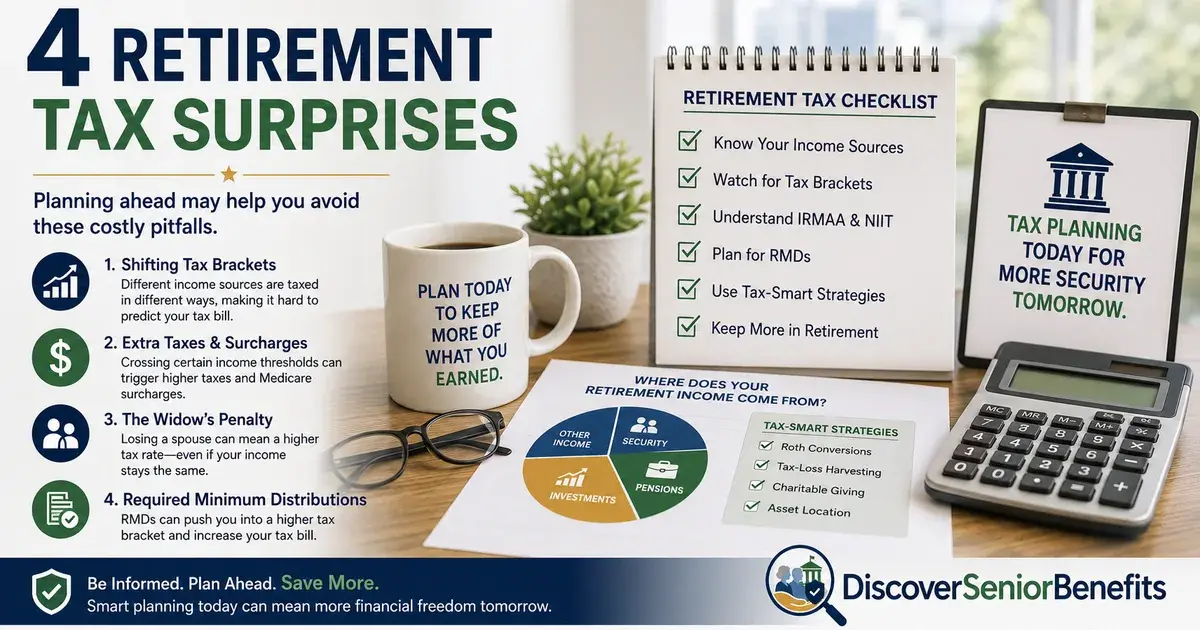
Retirement taxes can be more complicated — and more costly — than many people expect. Here are four common tax surprises retirees face, plus strategies to help reduce the impact.
Key takeaways
- Different income sources in retirement are taxed in different ways, making your tax bracket harder to predict than during your working years.
- Small income increases can trigger big consequences, including higher Medicare Part B and Part D premiums through IRMAA.
- Losing a spouse can push a surviving retiree into a higher tax bracket, a situation sometimes called the widow's tax.
- Common deductions from working years — mortgage interest, HSA contributions, workplace retirement plan contributions — often disappear in retirement.
- Strategies like Roth conversions, Qualified Charitable Distributions, and drawing from tax-free accounts can help manage taxable income.
- Meeting annually with a financial professional and tax advisor can help retirees stay prepared as tax rules and personal situations change.
Want to know which programs fit your situation? A free check shows what you may qualify for in about five minutes. No SSN.
Discover my benefitsWhy Retirement Taxes Can Catch You Off Guard
Many people expect their tax situation to get simpler once they stop working. In reality, it often gets more complicated. Retirement income comes from many sources — Social Security, traditional IRAs, 401(k)s, pensions, investments — and each is taxed differently. That mix makes it hard to predict your tax bracket or your total tax bill from year to year.
Financial professionals note that retirees are often surprised to go from receiving tax refunds during their working years to owing estimated taxes every quarter. Understanding the most common tax surprises can help you plan ahead.
Surprise 1: Shifting Tax Brackets
Your gross income will likely drop in retirement, but that doesn't always mean a lower tax rate. Social Security is a good example. The IRS uses a "combined income" formula — your adjusted gross income, any nontaxable interest, and half of your Social Security benefit — to determine how much of your benefit is taxable. Depending on where that number lands, anywhere from 0% to 85% of your Social Security income may be subject to federal tax. State tax treatment varies as well.
Other income types are taxed differently too:
- Ordinary income rates apply to withdrawals from traditional IRAs and 401(k)s, pension payments, non-qualified dividends, interest income, and some annuity income.
- Lower capital gains rates (currently a maximum 20% federal rate) apply to long-term capital gains and qualified dividends from investments held at least 61 days.
With so many moving parts, calculating your expected tax bracket in retirement can be very complicated.
Surprise 2: Extra Taxes and Medicare Surcharges
Even a small increase in income can trigger significant extra costs in retirement.
Net Investment Income Tax (NIIT): This is a 3.8% tax that applies to investment income — interest, dividends, capital gains, and passive business income — for individuals whose modified adjusted gross income (MAGI) exceeds certain thresholds. It can push effective capital gains tax rates as high as 23.8% before state and local taxes.
IRMAA (Income-Related Monthly Adjustment Amount): If your MAGI rises above certain levels, Medicare Part B and Part D premiums increase. IRMAA works like a "tax cliff" — earning just one extra dollar above a threshold can push you into a higher premium bracket. Importantly, IRMAA is based on your tax return from two years prior, so a one-time income event today (like a large Roth conversion) can raise your Medicare premiums years later.
If your income dropped due to a life change such as retirement or the death of a spouse, you can petition the Social Security Administration to have your IRMAA recalculated using a more recent income figure.
Surprise 3: The Widow's Tax Penalty
Losing a spouse is painful. It can also come with an unexpected tax hit. When a retiree becomes widowed, their filing status changes from married filing jointly to single. If their income stays roughly the same, they lose the larger standard deduction and other tax benefits that come with joint filing — which can push them into a higher tax bracket.
The IRS does offer a "qualifying surviving spouse" status that lets a newly widowed person file at joint rates for up to two years, but only if they have a dependent child. Most retirees do not qualify.
Additionally, a surviving spouse may face:
- Continued required minimum distributions (RMDs) from accounts inherited from the deceased spouse
- Potentially higher Social Security income, since the survivor can choose whichever benefit — their own or their spouse's — is larger (provided the couple was married at least 9 months before the spouse's death)
These factors combined can significantly increase taxable income at a time when the tax code offers fewer protections for single filers.
Surprise 4: Fewer Deductions Than Expected
Several deductions that reduced your tax bill during your working years may no longer be available in retirement:
- Mortgage interest deduction often disappears once the mortgage is paid off.
- Pre-tax retirement contributions end when employment income ends.
- HSA contributions are no longer allowed once you enroll in Medicare.
Medical expenses can be large in retirement, but the deduction only applies to unreimbursed costs that exceed 7.5% of your adjusted gross income — a high bar for many retirees.
A newer benefit for seniors: Starting in 2025 through 2028, individuals age 65 and older may claim up to a $6,000 deduction. Both spouses in a married couple filing jointly can claim it if both are 65 or older. However, this deduction phases out at higher incomes — above a MAGI of $75,000 for single filers and $150,000 for married joint filers. For every dollar earned within the phaseout range, the deduction is reduced by 6 cents (12 cents for married couples where both spouses are 65 or older).
Strategies to Help Manage Retirement Taxes
The good news: taxable income in retirement is something you can influence with the right planning. Here are several approaches to consider.
Stay below key thresholds. Track your taxable income throughout the year. Avoid large income-generating moves — like selling property, realizing big capital gains, or doing a large Roth conversion — if you're close to a threshold that would trigger IRMAA or reduce the senior deduction. Also remember that interest from savings accounts is taxed at ordinary income rates, and that interest from tax-exempt municipal bonds, while not federally taxable, is still counted when calculating MAGI for IRMAA purposes.
Map out tax-free income sources. Qualified withdrawals from Roth IRAs and Roth 401(k)s are tax-free after age 59½ (assuming assets have been in the account at least 5 years). HSA withdrawals for qualified medical expenses are also tax-free at any age. Interest from federally tax-exempt municipal bonds is not subject to federal income tax.
Use the "income valley" years. Many retirees have a window between leaving full-time work and when RMDs begin. During those years, income may be lower, creating an opportunity to convert traditional IRA or 401(k) funds to a Roth at a lower tax rate. This can reduce future RMDs and give you more flexibility later when Social Security, pensions, and RMDs all arrive at once.
Consider a Qualified Charitable Distribution (QCD). Anyone age 70½ or older can transfer up to $111,000 per person directly from an IRA to an eligible charity. The amount given is excluded from ordinary income and can count toward satisfying your RMD — helping you avoid a taxable withdrawal that would otherwise raise your income.
Plan ahead with professional help. Tax rules, health care costs, and personal situations change regularly. Working with a financial professional and a tax advisor each year can help you stay flexible and make decisions that align with your goals. Always confirm your specific situation with a qualified advisor, as eligibility and rules vary.
Programs in this article
- How to apply for Extra Help (Part D Low-Income Subsidy) →
- How to apply for Qualified Medicare Beneficiary (QMB) →
- How to apply for Specified Low-Income Medicare Beneficiary (SLMB) →
- How to apply for Qualifying Individual (QI) →
- How to apply for State Health Insurance Assistance Program (SHIP) →
- How to apply for Federal Credit for the Elderly or the Disabled (IRS Schedule R) →
See which of these programs you may qualify for. Free, no SSN, about five minutes.
Discover my benefitsSources
Program facts in this article trace to these official pages, the same ones the eligibility rules cite.
- Extra Help (Part D Low-Income Subsidy) · ssa.gov · Last verified · October 27, 2026
- Qualified Medicare Beneficiary (QMB) · medicare.gov · Last verified · October 27, 2026
- Specified Low-Income Medicare Beneficiary (SLMB) · medicare.gov · Last verified · October 27, 2026
- Qualifying Individual (QI) · medicare.gov · Last verified · October 27, 2026
- State Health Insurance Assistance Program (SHIP) · acl.gov · Last verified · October 27, 2026
- Federal Credit for the Elderly or the Disabled (IRS Schedule R) · irs.gov · Last verified · October 27, 2026
Not legal or financial advice. The agency makes the final eligibility decision.
Related articles
5 min read
Social Security & Medicare Penalties: How to Avoid Them
Millions of Americans pay more than they should because of Social Security and Medicare penalties they never saw coming. Here is what each penalty is, why it happens, and how to protect yourself.
4 min read
Medicare Open Enrollment 2026: Key Dates & Cost-Saving Programs
Medicare Open Enrollment runs October 15 to December 7, 2026. Here is what to do before the deadline — and two programs that can cut costs year-round.
5 min read
4 Retirement Health Care Decisions to Get Right
Missing a health coverage enrollment window in retirement can mean higher costs that last for years. Here are the four decisions that matter most — and how to approach each one.
Ask this article
Get answers about this article from the assistant on any paid plan.