· Updated · 4 min read
Retirement Savings Options for the Self-Employed
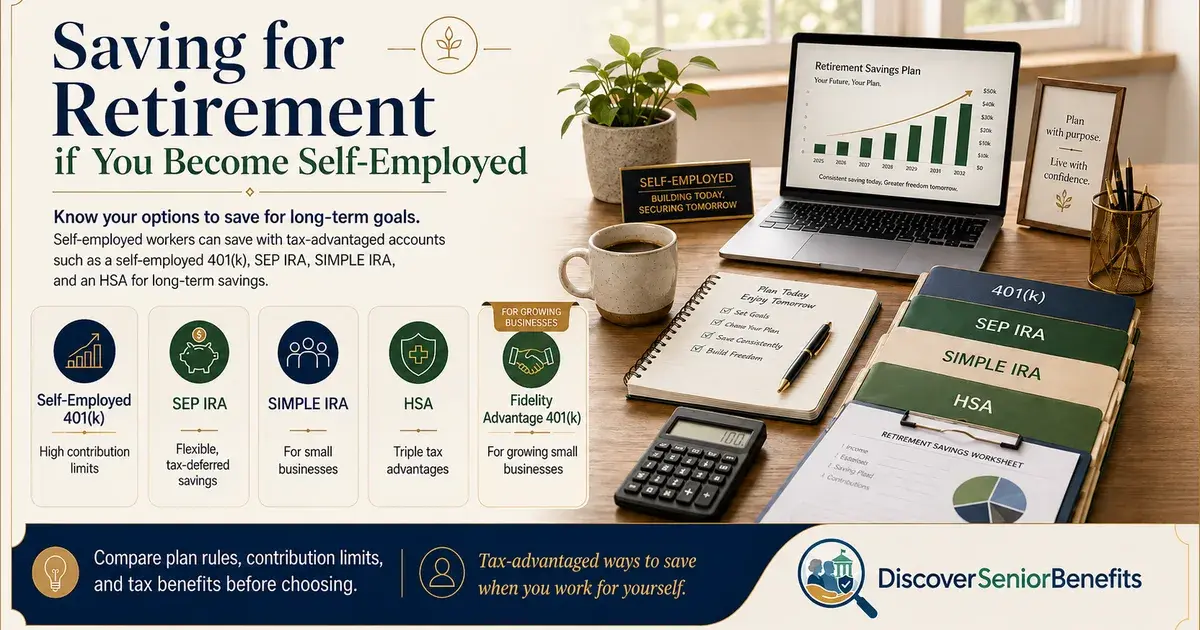
Going self-employed doesn't mean giving up on retirement savings. Several tax-advantaged accounts — including solo 401(k)s, SEP IRAs, and HSAs — can help you build a strong financial future on your own terms.
Key takeaways
- Self-employed workers can use tax-advantaged accounts — such as a solo 401(k), SEP IRA, or SIMPLE IRA — to save for retirement.
- Solo 401(k) contribution limits can reach up to $70,000 for tax-year 2025, with extra catch-up contributions allowed for those 50 and older.
- A Health Savings Account (HSA) offers triple tax advantages and savings that roll over year after year — they are not use-it-or-lose-it.
- If you are between ages 60 and 63, you may qualify for higher catch-up contribution limits in a solo 401(k).
- A traditional IRA or Roth IRA can serve as a starting point if you are not yet ready to open a business retirement plan.
Want to know which programs fit your situation? A free check shows what you may qualify for in about five minutes. No SSN.
Discover my benefitsWhy Retirement Savings Still Matter When You Work for Yourself
Leaving a traditional job often means leaving behind an employer-sponsored retirement plan. But going self-employed does not mean giving up on building retirement savings. Several tax-advantaged accounts are available specifically for self-employed individuals and small business owners.
Whether you plan to retire early or work well past the traditional retirement age, having a savings strategy in place matters. The good news: some self-employed accounts come with higher contribution limits than standard workplace plans.
Solo 401(k): High Limits for Solo Workers
A self-employed 401(k) — sometimes called a solo 401(k) — is designed for business owners who have no employees other than themselves or a spouse.
Because you contribute as both the employer and the employee, the limits are high:
- Up to $70,000 for tax-year 2025
- Up to $72,000 for tax-year 2026
If you are over age 50, you can add an extra catch-up contribution:
- $7,500 in 2025
- $8,000 in 2026
If you are between ages 60 and 63, an even higher catch-up amount applies — $11,250 in additional contributions for 2025.
Contributions can be made on a tax-deferred basis (traditional) or tax-free basis (Roth), depending on the plan setup.
SEP IRA: Simple Option for Individuals and Small Teams
A Simplified Employee Pension, or SEP IRA, works well for self-employed individuals or small businesses with one to four employees.
Key features:
- Contributions grow tax-deferred
- Contribution limits match the solo 401(k): up to $70,000 for 2025 and $72,000 for 2026
- Relatively simple to set up and maintain
A SEP IRA can be a strong choice if you want high contribution limits without the administrative complexity of a full 401(k) plan.
SIMPLE IRA: Built for Small Businesses with Employees
A SIMPLE IRA (Savings Incentive Match Plan for Employees) is designed for small businesses with fewer than 100 employees.
As the employer, you must choose one of two contribution approaches:
- A mandatory matching contribution of up to 3% of each employee's compensation, or
- A non-elective contribution of 2% of compensation for all eligible employees
Contribution limits for a SIMPLE IRA are lower than those of a solo 401(k) or SEP IRA, so it may be better suited for businesses that want to offer a retirement benefit without the higher funding requirements.
Other Account Options Worth Knowing
Fidelity Advantage 401(k): This is a pooled employer plan aimed at growing small businesses. It offers the higher contribution limits and employer match of a standard 401(k), but with a simpler plan design and reduced administrative work.
Traditional IRA or Roth IRA: If you are not yet ready to open a business retirement plan, a traditional IRA or Roth IRA can be a solid starting point. These accounts are available to individuals regardless of employment status and offer their own tax advantages.
Always confirm current contribution limits and eligibility rules with a qualified financial professional or the IRS, as rules can change year to year.
Using a Health Savings Account (HSA) for Long-Term Savings
If you are enrolled in an HSA-eligible health plan, a Health Savings Account (HSA) can serve as an additional long-term savings tool — not just a way to cover near-term medical bills.
For self-employed workers, HSA contributions can save 15.3% in taxes because you are paying as both employer and employee.
Three key benefits of an HSA:
- Triple tax advantage — Contributions may be tax-deductible, qualified medical expenses can be paid tax-free, and any investment growth is also tax-free.
- Investable — Unused HSA funds can be invested, potentially helping offset future health care costs in retirement.
- Not use-it-or-lose-it — Unlike a Flexible Spending Account (FSA), HSA balances roll over from year to year. The account stays with you even if you change insurance or move.
An HSA can be a powerful complement to a retirement account, especially given that health care is one of the largest expenses retirees face.
See which of these programs you may qualify for. Free, no SSN, about five minutes.
Discover my benefitsNot legal or financial advice. The agency makes the final eligibility decision.
Related articles
5 min read
Can Medicaid Pay You to Care for a Family Member?
Many states run Medicaid home care programs that may pay a relative or friend to provide care at home. Here is how they work, who may qualify, and what caregivers should watch for.
5 min read
Social Security & Medicare Penalties: How to Avoid Them
Millions of Americans pay more than they should because of Social Security and Medicare penalties they never saw coming. Here is what each penalty is, why it happens, and how to protect yourself.
4 min read
Caregiver Pay and Social Security Benefits for Families
Some states pay family members to care for a loved one at home, and Social Security has benefits for caregivers, spouses, and disabled adult children. Here is what to know before you apply.
Ask this article
Get answers about this article from the assistant on any paid plan.