
· 5 min read
Medicare Part D Changes, Social Security Tips, and What Seniors Need to Know Now
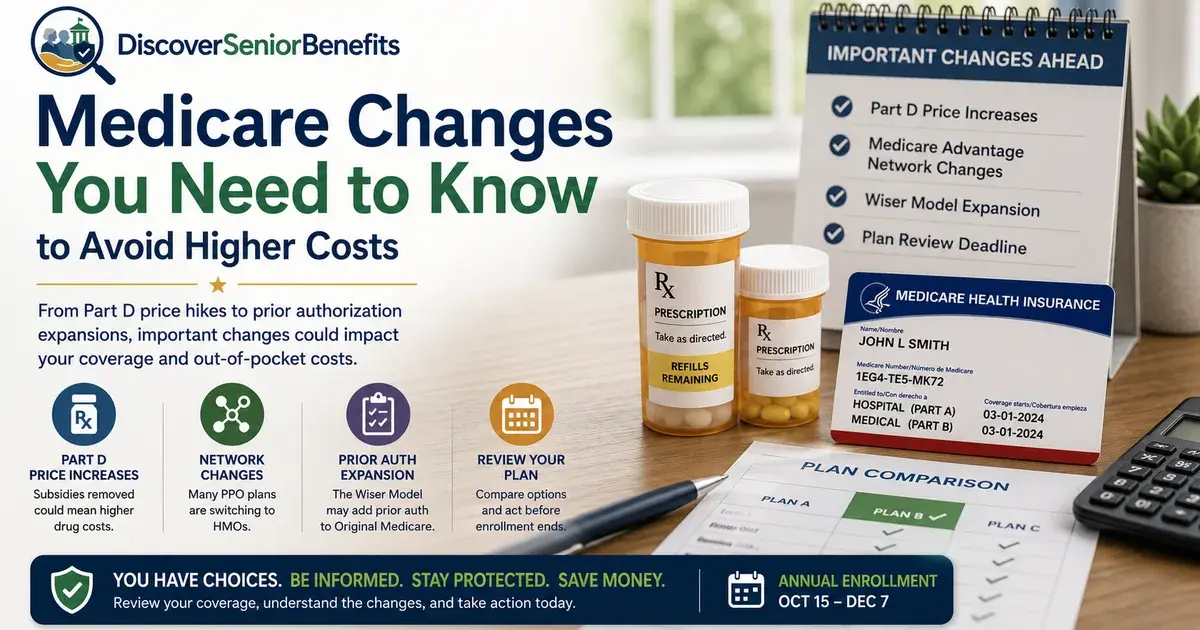
Major shifts in Medicare Part D drug coverage and Medicare Advantage plans are coming. Here is what seniors and caregivers need to understand — and do — before open enrollment.
Key takeaways
- The federal Part D subsidy is being eliminated, meaning prescription drug plan costs could rise significantly — but no one knows by exactly how much yet.
- Many Medicare Advantage plans are switching from PPOs to HMOs, which can limit which doctors you can see.
- A new pilot program called the WISE-R model is testing prior authorization requirements for original Medicare in six states, including Arizona, New Jersey, Ohio, and Texas.
- Do not cancel your Part D prescription drug plan — dropping it triggers a permanent late-enrollment penalty of 1% per month you went without coverage.
- Low-income seniors may qualify for Extra Help (Low-Income Subsidy) or a Medicare Savings Program to reduce drug and Part B costs.
- Collecting Social Security disability benefits does not cause you to lose Medicare if you also claim spouse, divorce spouse, or survivor benefits.
Medicare Advantage Plans Are Changing Networks
Many Medicare Advantage companies are switching from PPO plans to HMO plans. Here is the difference:
- PPO (Preferred Provider Organization): You can usually see any doctor who accepts Medicare, even out of network, though you may pay more.
- HMO (Health Maintenance Organization): You are limited to a specific network of doctors. Going outside that network typically means paying the full cost yourself.
If you currently have a PPO Medicare Advantage plan, check whether your plan is switching to an HMO for next year. Most importantly, confirm that your current doctors are still in your new network. You will receive an Annual Notice of Change (ANOC) from your plan by the end of September. Read it carefully — the plan details can change even if you keep the same insurance card.
If you have a Medicare supplement plan (like Plan G or Plan N), this network issue does not apply. You can see any doctor in the country who accepts Medicare.
The WISE-R Model: Prior Authorization Coming to Original Medicare
A pilot program is testing prior authorization requirements for original Medicare — something that previously only applied to Medicare Advantage plans. Prior authorization means an insurance company must approve a procedure before your doctor can perform it.
This pilot, called the WISE-R model, is currently being tested in six states: Arizona, New Jersey, Ohio, Oklahoma, Texas, and Washington. It covers 17 specific procedures. If you live in one of those states and have original Medicare with a supplement plan, you could be affected.
Decisions under this model are reportedly being made with AI assistance, and the companies reviewing claims are said to earn a share of what they save — meaning there is a financial incentive to deny care. If you believe a claim has been wrongly denied under this program, contact your doctor and consider appealing the decision. Reaching out to your elected representatives is another option.
Medicare Part D Drug Costs: What Is Changing and Why
The federal government previously subsidized Medicare Part D prescription drug plans to keep costs lower for enrollees. That subsidy is being eliminated. Here is what that means:
- No one knows yet exactly how much premiums, co-pays, or drug tiers will change for any individual plan.
- The average increase has been estimated at around $10 per month across all enrollees, but individual costs could be much higher depending on your specific plan and medications.
- Insurance companies may respond by raising co-insurance rates, moving drugs to higher cost tiers, or increasing prior authorizations — rather than raising premiums directly.
- The $2,100 annual out-of-pocket cap on prescription drug costs (put in place by the previous administration) remains in effect for this year.
Watch for your ANOC letter in late September. It will spell out exactly what your plan will cost and cover starting January 1st. Do not assume your plan stays the same just because you do nothing — the coverage details can change significantly.
Do Not Drop Your Part D Plan — The Penalty Is Permanent
Some people consider dropping their Part D prescription drug plan if they feel they do not need it right now. This is a costly mistake.
If you do not enroll in Part D when you are first eligible and later decide you want it, you will pay a late-enrollment penalty for the rest of your life. The penalty is 1% of the average national Part D premium for every month you went without coverage. For example:
- 12 months without coverage = 12% added to your premium permanently
- 24 months without coverage = 24% added permanently
The same logic applies to Medicare Part B (the medical coverage part). If you delay Part B enrollment without a qualifying reason, you pay a 10% penalty for every 12-month period you went without it.
Even if you rarely use prescriptions now, keep your Part D plan. Insurance exists for when you need it unexpectedly.
Help Paying for Medicare: Extra Help and Medicare Savings Programs
Two programs can help low-income seniors manage Medicare costs:
Extra Help (Low-Income Subsidy — LIS) This federal program helps pay for Part D prescription drug costs. You apply through the Social Security Administration. It is one of the simpler Social Security applications available. If you or someone you know is struggling to afford prescriptions, this is a good first step.
Medicare Savings Programs (MSP) These state-run programs can help pay your Medicare Part B premium (currently $229.90 per month) and sometimes other Medicare costs. You apply through your state's Medicaid office. Eligibility rules vary by state, and some states have relatively generous income and resource limits.
Both programs are worth applying for even if you are unsure you qualify. Always confirm current eligibility rules with the administering agency, as rules and funding levels are subject to change.
Social Security: Common Mistakes That Cost Seniors Money
Several Social Security rules trip up seniors and caregivers regularly:
Divorce spouse benefits If you were married to someone for at least 10 years and are now divorced, you may be able to collect benefits based on your ex-spouse's record — even if they are still working and not yet collecting. Your own benefit is not reduced or eliminated. You simply receive the higher of your own benefit or the additional amount from your ex's record. You can also switch between ex-spouses' records if circumstances change.
Collecting disability and spouse/survivor benefits at the same time Many people on Social Security Disability Insurance (SSDI) believe that claiming spouse, divorce spouse, or survivor benefits will cause them to lose their own disability check or their Medicare. This is not correct. If you are entitled to additional money from a spouse's or ex-spouse's record, you receive both. Your Medicare coverage continues.
Starting Social Security early does not lock you in forever If you claimed benefits at 62 and kept working, your benefit can still increase in three ways:
- Annual cost-of-living adjustments (COLA)
- Automatic recalculation if a new year of earnings becomes one of your highest 35 years (called the Actuarial Reduction Factor adjustment)
- Reduction of early-filing penalties if benefits were suspended during certain months
Social Security earnings record errors Check your Social Security earnings record for accuracy. If wages are listed incorrectly, raise the issue when you apply — ideally by speaking with a claims specialist directly rather than submitting a correction separately, which can sit unprocessed for months.
The date last insured for disability To qualify for SSDI, you generally must have worked at least five of the last ten years before becoming disabled. If you wait too long after stopping work to apply, you may no longer be insured for disability benefits. This deadline catches many people off guard.
Protecting Your Medicaid and Medicare Coverage
States are facing significant Medicaid funding reductions. As a result, many states are expected to make it harder to enroll in or keep Medicaid coverage. Here is how to protect yourself or someone you care for:
- Keep your address current with Medicaid and Social Security at all times.
- Open and respond to every piece of mail from these agencies promptly. Missing a deadline — even due to agency error — can result in losing coverage.
- Make copies of everything you submit.
- Appeal any denial. If you are cut off from Medicaid or Medicare Savings Program benefits, you have the right to appeal. Do not give up after a first denial.
- If you receive an inheritance or other income while on Medicaid or SSI, report it to the agency right away. Failing to report can result in being asked to repay months of benefits.
If you have Medicaid and are also enrolled in Medicare, the state typically pays your Part B premium. Losing Medicaid would mean that cost falls back on you. Fight to keep it.
Always confirm your specific situation with the relevant state or federal agency, as rules and funding are changing rapidly.
Programs in this article
- How to apply for Extra Help (Part D Low-Income Subsidy) →
- How to apply for Qualified Medicare Beneficiary (QMB) →
- How to apply for Specified Low-Income Medicare Beneficiary (SLMB) →
- How to apply for Qualifying Individual (QI) →
- How to apply for State Health Insurance Assistance Program (SHIP) →
- How to apply for Supplemental Security Income (SSI) →
See which of these programs you may qualify for. Free, no SSN, about five minutes.
Find my benefitsSources
Program facts in this article trace to these official pages, the same ones the eligibility rules cite.
- Extra Help (Part D Low-Income Subsidy) · ssa.gov · Last verified · September 14, 2026
- Qualified Medicare Beneficiary (QMB) · medicare.gov · Last verified · September 14, 2026
- Specified Low-Income Medicare Beneficiary (SLMB) · medicare.gov · Last verified · September 14, 2026
- Qualifying Individual (QI) · medicare.gov · Last verified · September 14, 2026
- State Health Insurance Assistance Program (SHIP) · acl.gov · Last verified · September 14, 2026
- Supplemental Security Income (SSI) · ssa.gov · Last verified · September 14, 2026
Not legal or financial advice. The agency makes the final eligibility decision.
Related articles
5 min read
Social Security Benefits You May Be Missing — A Plain-Language Guide
Billions of dollars in Social Security benefits go unclaimed every year. Here is a clear breakdown of the most commonly missed programs — from divorce spouse benefits to disability work rules — so you can make sure you are getting every dollar you earned.
5 min read
Social Security Benefits Most Seniors Don't Know About
An estimated $30 billion in benefits goes unclaimed every year. Here is a plain-language guide to the Social Security programs, Medicare options, and appeal rights that seniors and caregivers most often miss.
5 min read
Social Security Trust Fund 2034: What a 19% Cut Means for You
The latest Social Security trustees report moved the trust fund depletion date up by a year — to 2034. Here is what that means for current and future beneficiaries, and what options exist to protect your income.
Ask this article
Get answers about this article from the assistant on any paid plan.