· Updated · 5 min read
Senior Benefits You May Be Missing — Health, Housing & More
Billions of dollars in senior benefits go unclaimed every year because people don't know what's available. Here's a plain-language guide to health care, housing, food, veterans programs, and money-saving tips for older adults and their caregivers.
Key takeaways
- Never self-reject from a benefit program — always apply and let the agency decide eligibility.
- Medicaid, not Medicare, covers long-term care costs such as nursing home stays.
- If you are on Medicaid and own a home, look into your state's estate recovery rules and protections such as irrevocable trusts and the Lady Bird deed.
- ABLE accounts let people whose disability began before age 46 save money without losing SSI, Medicaid, or SNAP benefits.
- Section 8 and Section 202 senior housing have separate waiting lists — apply for both.
- Veterans may qualify for VA disability pay and SSDI at the same time; one does not automatically cancel the other.
Why So Many Benefits Go Unclaimed
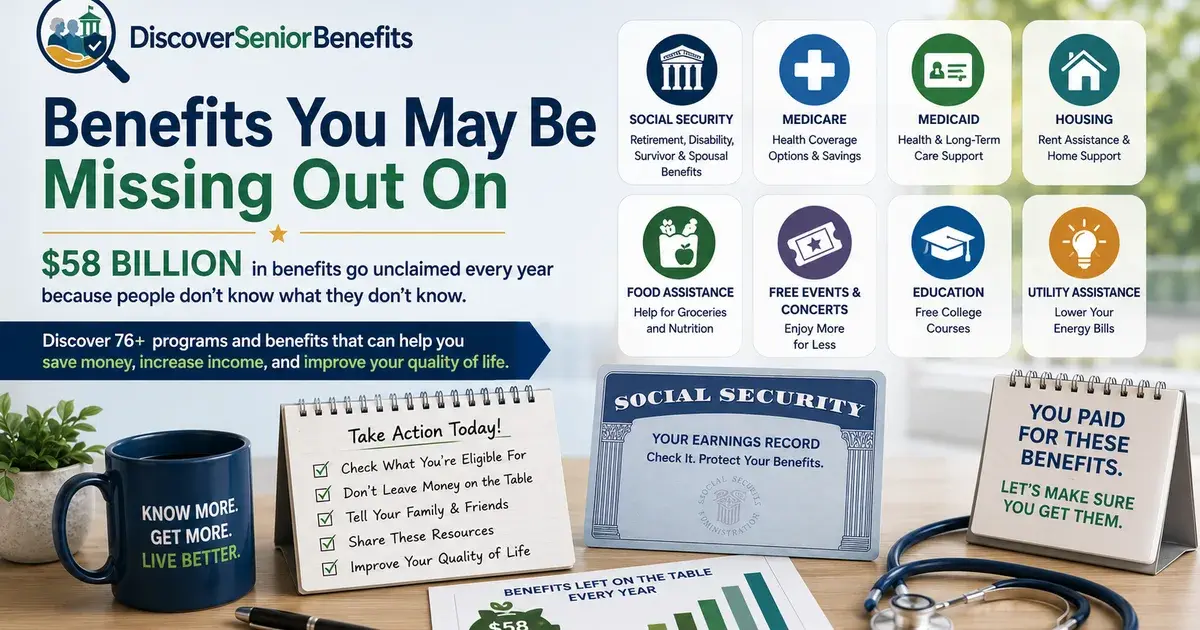
An estimated $58 billion in benefits goes unclaimed every year. The main reasons: people don't know a program exists, they assume they won't qualify, or the application process feels too hard.
The most important rule is never self-reject. Don't decide on your own that you're ineligible. Apply and let the agency make that call. Programs have exceptions to their rules, and a small amount over an income limit may be correctable through exemptions or an appeal.
Medicaid and Long-Term Care
Medicaid — called different names in different states — is a needs-based program for people with low income and limited resources. Medicare does not cover long-term care. Medicaid does. If a nursing home stay is needed, Medicaid is typically what pays for it.
A few important Medicaid facts:
- Spousal protection: If one spouse enters a nursing home on Medicaid, the healthy spouse at home is generally protected from losing all household income and assets. Rules vary by state, so confirm details with your state Medicaid office.
- Estate recovery: After a Medicaid recipient passes away, the state may seek repayment from the estate, including the home. Some people place their home in an irrevocable trust to protect it, but states can look back five years. The transfer must happen at least five years before Medicaid is needed.
- Lady Bird deeds: Some states allow a special deed that protects the home from estate recovery without the five-year wait. Check whether your state offers this option.
- Appeals: If Medicaid is denied or reduced by a small amount, always appeal. Calculations can contain errors, and certain expenses may be excluded from the income count.
ABLE Accounts — Saving Without Losing Benefits
For people receiving welfare-based benefits like SSI, Medicaid, or SNAP, there are strict limits on how much money you can have saved. SSI, for example, has a resource limit of $2,000.
ABLE accounts are a legal way around this limit. If your disability began before age 46 (recently expanded from age 26), you can open an ABLE account and save money for disability-related expenses — such as a wheelchair-accessible van or home modifications — without that money counting against your benefit limits.
You do not have to open an ABLE account in your home state. Many states offer them, and you can choose any state's program.
Housing Help for Seniors
Finding affordable housing is harder than ever, but several programs exist:
- Section 8 Housing Choice Vouchers: Rental assistance with waiting lists that can stretch two years or more. Apply to multiple housing authorities and watch for new apartment buildings in your area — new developments sometimes open their own waiting lists.
- Section 202 Senior Housing: HUD-funded housing specifically for low-income adults 62 and older, with supportive services. This has its own separate waiting list from Section 8. Apply for both.
- USDA Section 504: Low-interest loans and grants for homeowners 62 and older in rural areas who need repairs.
- Habitat for Humanity: Beyond building homes, local affiliates often help with repairs, ramps, appliances, and weatherization through their ReStore programs.
- Low-Income Housing Tax Credit (LIHTC) properties: Privately built apartments that offer below-market rents (often 30–60% of market rate). These also have waiting lists but can be higher quality.
- Emergency rent help: Federal emergency funds have largely ended, but county-level programs may still have money. Check federal, state, county, and city resources — and check back regularly, since funding allocations change.
Energy Bills, Food, and Everyday Savings
Energy assistance: The Low Income Home Energy Assistance Program (LIHEAP) can help with heating and cooling costs. If funds are unavailable when you call, try again — allocations arrive throughout the year. Also ask your utility company about budget billing, which spreads costs evenly across the year so summer or winter spikes don't create a crisis.
Free home weatherization: The Weatherization Assistance Program (WAP) provides free energy-efficiency upgrades. Being on SSI or SNAP can make it easier to qualify for WAP and similar programs.
SNAP (food stamps): Your home and primary vehicle are generally exempt from SNAP resource counts. Don't assume you're ineligible because you own a house or a car. Apply at the same office that handles Medicaid — in most states it's the same agency.
Other food resources:
- Senior Farmers' Market Nutrition Programs provide vouchers for fresh produce.
- Home-delivered meals (Meals on Wheels) and congregate meals at senior centers are available in most communities.
- Feeding America food banks are seeing more demand; find a local food bank if needed.
Your EBT card opens other doors: Many museums, national parks, and cultural institutions offer free or discounted admission to EBT cardholders. Ask wherever you go.
Property tax relief: Homestead exemptions, senior freezes, and veteran exemptions can significantly reduce property tax bills. Programs vary by state and county — contact your local tax assessor's office to find out what's available where you live.
Veterans Benefits
Veterans have access to a range of benefits that are often underclaimed:
- VA disability and SSDI: You can receive both at the same time. A VA disability rating does not automatically qualify you for SSDI, and VA disability pay does not reduce your SSDI amount.
- VA health care: Lower-income veterans are assigned to priority groups that affect cost-sharing. If you can't afford Medicare Part B, options include Medicaid or certain Medicare Advantage plans — but dropping Part B can trigger a permanent penalty if you later want it back. Think carefully before making that decision.
- Aid and Attendance: This VA benefit helps wartime veterans and surviving spouses who need help with daily activities. It is widely underclaimed. Contact your state or county veterans service office for free help applying.
- Free tickets and events: Some organizations offer free or discounted tickets to concerts, sporting events, and other activities for veterans. Ask at your local veterans service office about what's available in your area.
Free VA claims assistance is available through state and county veterans service officers — you should never have to pay someone to file a VA claim.
Health Care Options Beyond Medicaid
Nonprofit hospitals and charity care: Under federal law, nonprofit (501c3) hospitals must provide charity care to patients who cannot pay. If you or a family member faces a large hospital bill from a nonprofit hospital, ask for financial assistance right away. It helps to know in advance which hospitals near you are nonprofit — make a list and share it with family members or neighbors who might drive you in an emergency.
Community health centers: A nationwide network of federally qualified health centers offers primary care, dental, and behavioral health services on a sliding-fee scale, regardless of insurance status. Search for one near you.
Free and low-cost dental care:
- Dental schools provide cleanings, fillings, and other basic services at low or no cost, supervised by licensed dentist instructors.
- The Dental Lifeline Network connects people with volunteer dentists.
Respite care for caregivers: If you are caring for a parent, spouse, or other family member, respite programs can give you a temporary break. Funding has been reduced in many areas, but programs still exist — contact your local Area Agency on Aging to find out what's available.
Long-term care insurance: Premiums have become very expensive. For many people, Medicaid has been the fallback for long-term care costs. With Medicaid funding under pressure, planning ahead is more important than ever. Confirm details with a benefits counselor or elder law attorney in your state.
Social Security Tips and Common Mistakes
A few Social Security facts worth knowing:
- Replacement Social Security cards are free (up to 10 in a lifetime). Never pay a fee for the card itself or for the application form.
- SSI rules are not everyone's rules. SSI (Supplemental Security Income) is a welfare-based program with strict income and resource limits. Most Social Security retirement and disability benefits do not have those same limits. Be cautious of online videos that confuse the two.
- COLA announcements: The official cost-of-living adjustment for the following year is announced in October. Any video claiming to know the next year's COLA before October is guessing.
- Disabled Adult Child (DAC) benefits: A child who became disabled before age 22 can receive benefits on a parent's Social Security record — 50% if the parent is alive and receiving benefits, up to 75% if the parent is deceased. These benefits continue into adulthood as long as the disability continues.
- Surviving spouse benefits can begin as early as age 60 (or age 50 if the surviving spouse is also disabled).
- Working after claiming early: If you claimed Social Security early and then worked, your benefit may have been adjusted upward automatically at full retirement age through the Adjustment of the Reduction Factor (ARF). Your benefit also recalculates automatically each year you work and pay into Social Security, even after full retirement age.
Always check your Social Security earnings record to make sure it is accurate. Errors in the record can affect your benefit amount.
Programs in this article
- How to apply for SNAP (Supplemental Nutrition Assistance Program) for Seniors →
- How to apply for Qualified Medicare Beneficiary (QMB) →
- How to apply for VA Aid & Attendance (Improved Pension) →
- How to apply for VA Health Care →
- How to apply for Housing Choice Voucher (Section 8) →
- How to apply for HUD Section 202 Supportive Housing for the Elderly →
See which of these programs you may qualify for. Free, no SSN, about five minutes.
Find my benefitsSources
Program facts in this article trace to these official pages, the same ones the eligibility rules cite.
- SNAP (Supplemental Nutrition Assistance Program) for Seniors · fna.usda.gov · Last verified · September 16, 2026
- Qualified Medicare Beneficiary (QMB) · medicare.gov · Last verified · September 16, 2026
- VA Aid & Attendance (Improved Pension) · va.gov · Last verified · September 16, 2026
- VA Health Care · va.gov · Last verified · September 16, 2026
- Housing Choice Voucher (Section 8) · hud.gov · Last verified · September 16, 2026
- HUD Section 202 Supportive Housing for the Elderly · hud.gov · Last verified · September 16, 2026
Not legal or financial advice. The agency makes the final eligibility decision.
Related articles
5 min read
Social Security, Medicare & Benefits: What Many Seniors Miss
From filing the right Social Security claim to avoiding Medicare penalties, several common mistakes cost seniors real money. Here is a plain-language guide to the programs and rules most people overlook.
4 min read
Moving a Parent Across State Lines: What Happens to Their Benefits
When an aging parent moves to a new state, some benefits follow automatically — others restart from zero, and a few disappear entirely. Here is what families need to know before the moving truck pulls out.
4 min read
The 30-Day Caregiver Checklist: Benefits First
When a parent suddenly needs help, most families rush to hire a lawyer. A smarter move is to secure unclaimed benefits first — they affect cash flow and healthcare access right now. Here is a four-week action plan.
Ask this article
Get answers about this article from the assistant on any paid plan.