· 4 min read
TrumpIRA and the Federal Saver's Match: What Retirees Should Know
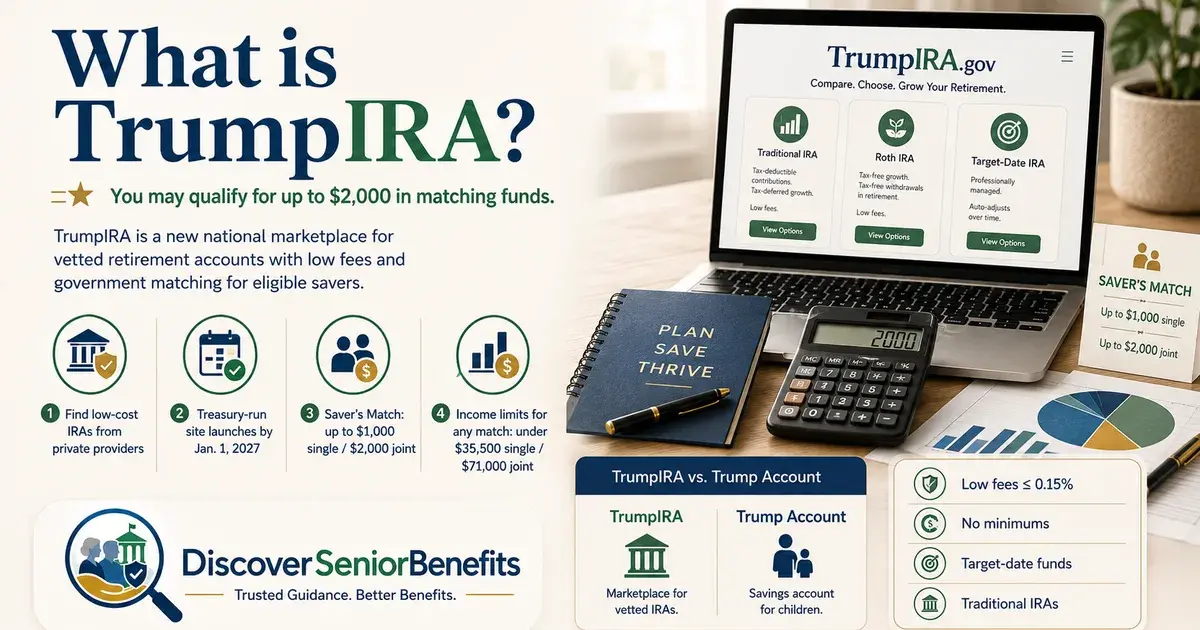
A new government website called TrumpIRA.gov is set to launch by January 1, 2027, connecting low- and middle-income workers to vetted private IRAs — and a federal matching contribution of up to $2,000 a year.
Key takeaways
- TrumpIRA.gov is a government-run website — not a government account — that lists low-cost, vetted IRAs from private financial institutions.
- The site is scheduled to launch by January 1, 2027.
- Eligible lower- and middle-income savers can receive a Federal Saver's Match of up to $1,000 (single filers) or up to $2,000 (joint filers) deposited directly into their IRA.
- To get the full match, single filers must earn $20,500 or less (MAGI); joint filers must earn $41,000 or less.
- No match is available if a single filer earns $35,500 or more, or if joint filers earn $71,000 or more.
- Withdrawals from these traditional IRAs are penalty-free starting at age 59½ and are subject to ordinary income tax.
What Is TrumpIRA?
TrumpIRA is a website being built by the U.S. Treasury. It is not a new type of retirement account. Instead, it works like a marketplace — a place where savers can compare traditional IRAs offered by private financial institutions that have met the government's cost and quality standards.
The site is scheduled to go live by January 1, 2027. It was created through an executive order signed on April 30, directing the Treasury to build and run the platform.
TrumpIRA is separate from "Trump Accounts," which are custodial savings accounts for children under 18 and are part of a different law.
Who Can Use TrumpIRA?
The site is designed for workers who do not have access to an employer-sponsored retirement plan. That includes:
- Small business employees
- Part-time workers
- Independent contractors
- Self-employed individuals
There is no income limit for browsing the site and opening an IRA. However, income limits do apply if you want to receive the federal matching contribution (see below).
More than 15% of private industry workers have employers that offer no pension or retirement savings plan, according to the Bureau of Labor Statistics. TrumpIRA aims to give those workers a straightforward path to saving.
What Makes These IRAs Different?
Every IRA listed on TrumpIRA.gov must meet specific Treasury standards:
- Low costs: Net expense ratios of no more than 0.15%, so more of your money stays invested.
- Diversified options: Funds and ready-made portfolios, including target-date funds that automatically become more conservative as you near retirement.
- No minimums: No required minimum contribution or balance to get started.
- Appropriate risk: Investment options are not riskier than comparable investments on the market.
The investment menu is similar to the low-cost options available to federal employees and military members through the Thrift Savings Plan (TSP).
These are traditional IRAs. Contributions may be tax-deductible depending on your income. Earnings grow tax-deferred, meaning you pay no taxes on growth until you withdraw the money.
The Federal Saver's Match: Free Money for Eligible Savers
The biggest benefit for lower- and middle-income savers is the Federal Saver's Match, which comes from the SECURE 2.0 legislation. The government deposits matching funds directly into your qualifying IRA — you do not have to wait until tax time.
How much can you receive?
- Single filers: up to $1,000 per year
- Joint filers (married couples filing together): up to $2,000 per year
Income limits for the full match:
- Single filers: modified adjusted gross income (MAGI) of $20,500 or less
- Joint filers: MAGI of $41,000 or less
Income limits to receive any match at all:
- Single filers: MAGI must be under $35,500
- Joint filers: MAGI must be under $71,000
The match phases out gradually between those thresholds. The government matches 50% of your contributions, so a single filer needs to contribute $2,000 to earn the full $1,000 match. A joint filer needs to contribute $4,000 to earn the full $2,000 match.
Important: The Saver's Match does not count toward your annual IRA contribution limit. However, it may be subject to an extra tax if withdrawn early.
Contribution Limits and Withdrawal Rules
Annual contribution limits for 2026:
- Up to $7,500 for most savers
- Up to $8,600 if you are age 50 or older (an extra $1,100 catch-up contribution)
You can only contribute up to your earned income for the year if that amount is less than the limit.
Withdrawal rules:
- Penalty-free withdrawals begin at age 59½
- Withdrawals before 59½ face a 10% early withdrawal penalty plus ordinary income tax
- Some exceptions waive the penalty (but not the tax), such as paying health insurance premiums while unemployed or up to $10,000 for a first home purchase
- All withdrawals from these traditional IRAs are taxed as ordinary income
How to Get Started When the Site Launches
When TrumpIRA.gov goes live by January 1, 2027, here are the basic steps to open an account:
- Visit the site and compare IRAs by fees, investment options, and provider reputation.
- Choose a provider and follow their instructions to open an account — you will need personal details like your Social Security number and a photo ID.
- Fund your account by linking a bank account or transferring from an existing account at the same institution.
- Invest your money by selecting from the available low-cost investment options rather than leaving it in a default cash position.
- Claim the Saver's Match if you are eligible — follow the site's instructions to receive the government's matching deposit.
Always confirm eligibility details and income thresholds with the relevant agency, as rules may change before the site launches.
See which of these programs you may qualify for. Free, no SSN, about five minutes.
Find my benefitsNot legal or financial advice. The agency makes the final eligibility decision.
Related articles
5 min read
4 Retirement Tax Surprises and How to Manage Them
Retirement taxes can be more complicated — and more costly — than many people expect. Here are four common tax surprises retirees face, plus strategies to help reduce the impact.
4 min read
Retirement Savings Options for the Self-Employed
Going self-employed doesn't mean giving up on retirement savings. Several tax-advantaged accounts — including solo 401(k)s, SEP IRAs, and HSAs — can help you build a strong financial future on your own terms.
4 min read
4 Options for Your Old Workplace Retirement Savings
Leaving a job means deciding what to do with your retirement savings. Here are the four main choices — and what each one means for your taxes, growth, and future income.
Ask this article
Get answers about this article from the assistant on any paid plan.