· 4 min read
How Seniors Can Get Help Paying Heating Bills This Winter
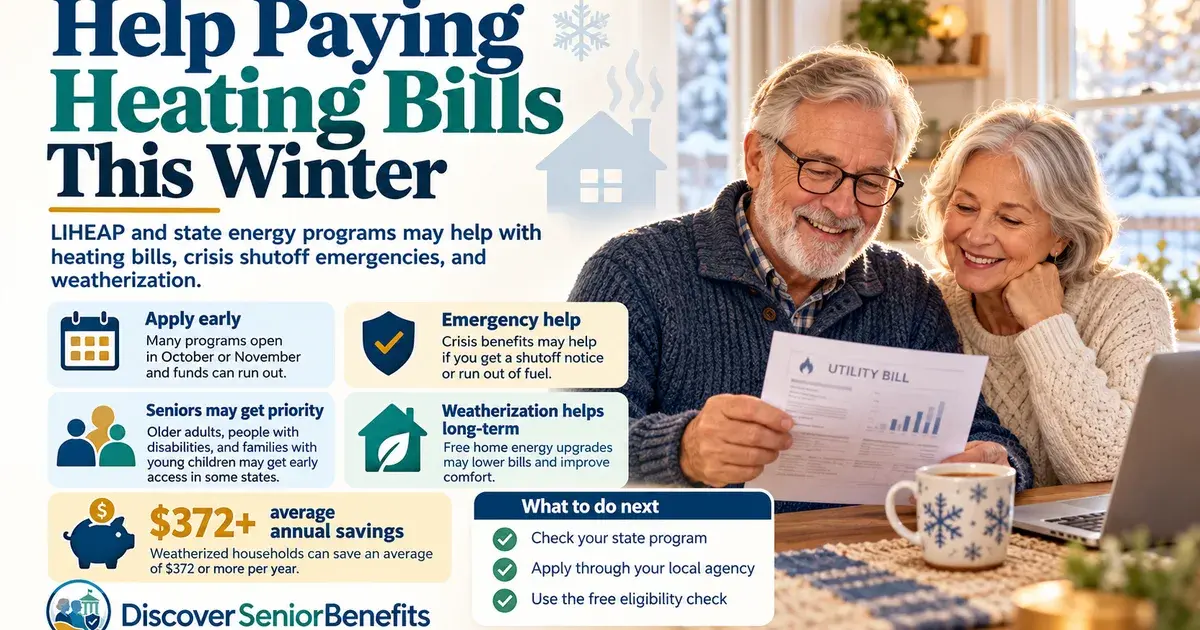
Federal LIHEAP funding flows to every state as a heating-bill assistance program — and seniors often get priority access. Here is what to know about eligibility, how to apply, and the long-term fix that cuts energy bills for good.
Key takeaways
- LIHEAP is a federal program that funds heating help in every state — look for it under names like HEAP, CEAP, EAP, LIEAP, or Fuel Assistance depending on where you live.
- Many states give seniors 60 or 65 and older an earlier application window, so applying as soon as your state opens enrollment is important.
- Most programs pay the utility or fuel company directly — you do not handle the money yourself.
- Crisis or emergency components can help even after a shut-off notice arrives or service is already off.
- The Weatherization Assistance Program (WAP) offers free home energy upgrades that can save households an average of $372 or more a year on energy bills.
- Applying is always free — never pay a fee or share bank login credentials with anyone offering to apply on your behalf.
Want to know which programs fit your situation? A free check shows what you may qualify for in about five minutes. No SSN.
Find my benefitsWhat LIHEAP Is and How It Works
The federal Low Income Home Energy Assistance Program (LIHEAP) sends money to every state, and each state runs its own version — sometimes under a different name:
- HEAP (Ohio, New York, Wisconsin)
- CEAP (Texas)
- EAP (Indiana, Minnesota)
- LIEAP (North Carolina)
- Fuel Assistance (Massachusetts)
Most programs offer two layers of help:
- Regular heating benefit — a one-time seasonal payment credited to your utility or fuel account.
- Crisis or emergency help — extra assistance when a shut-off notice arrives or service is already off.
Payments almost always go straight to the utility or fuel company, not to the household. Applications typically open in October or November, and funds can run out, so applying early matters. Rules, income limits, and program seasons differ by state.
Seniors Often Get Priority
Many states give older adults — usually those 60 or 65 and older — an earlier start date or priority status:
- Georgia: Seniors 65+ and medically homebound residents can apply for heating help starting the first workday of December, ahead of the general public.
- North Carolina (LIEAP): Households with someone 60 or older can apply starting December 1; everyone else waits until January 1.
- Illinois: Seniors 60+ and people with disabilities get priority and early application access.
- Indiana, Texas, Florida, New York: Priority is given to households that include a senior, a person with a disability, or a young child.
In many states, seniors can apply at their local Area Agency on Aging or community action agency rather than navigating a state website alone.
Income Limits by State
Each state sets its own income threshold. Most use either 60% of the State Median Income or 150% of the Federal Poverty Level. A few examples:
- Arizona: ~$33,690/year for one person (60% State Median Income, FFY 2026)
- Indiana: ~$34,635/year for one person (60% State Median Income, PY 2027)
- Massachusetts (Fuel Assistance): $53,585 for one person, $70,073 for two
- Michigan: Monthly income at or below $1,956 for one person, $2,644 for two (150% FPL)
- Minnesota: At or below 50% of state median income; heating benefits range from $200 to $1,400
- Missouri: Monthly income at or below $2,840 for one person, $3,714 for two, with $3,000 or less in bank accounts, retirement accounts, or investments
- New Jersey: $51,273/year for one person, $67,049 for two (60% State Median Income)
- Ohio: ~$27,930 for a single person, ~$37,870 for a couple (175% FPL)
- Tennessee: ~$32,053/year for one person (60% State Median Income, FFY 2026)
- Texas (CEAP): $23,940/year for one person (150% FPL, 2026)
- Virginia: Monthly gross income at or below $1,956 for one person, $2,643 for two (150% FPL)
- Washington: Monthly income at or below $1,956 for one person, $2,644 for two (150% FPL)
- Wisconsin (WHEAP): $38,421/year for one person, $50,243 for two (60% State Median Income, 2025–2026)
Households already receiving SNAP or cash assistance are often automatically income-eligible. Always confirm current limits with your local agency, as thresholds are updated each program year.
The Long-Term Fix: Weatherization Assistance
Heating bill help covers this season's costs. The Weatherization Assistance Program (WAP) addresses the root cause — a home that leaks heat and wastes energy.
After a free professional energy audit, local providers install upgrades at no cost to the household. Common improvements include:
- Attic and wall insulation
- Air-sealing and weatherstripping
- Duct sealing and HVAC tune-ups or replacement
- Water-heater wraps and LED lighting
- Smart thermostats
- Refrigerator replacement (for very old, high-draw units)
- Carbon-monoxide detector installation
Households that get weatherized save an average of $372 or more a year on energy bills, according to the Department of Energy. WAP is open to both homeowners and renters. Households that qualify for heating bill help often qualify for weatherization too — the two programs are frequently linked at the local agency level.
California's LIHEAP also includes its own Low-Income Weatherization Program, and Pennsylvania's LIHEAP has a built-in weatherization component.
How to Apply
The application process is similar across states:
- Find your local agency. Most states route applications through Community Action Agencies, county Departments of Social Services, or Area Agencies on Aging. Some states also offer online portals.
- Apply early. Many programs open in October or November. Funds are limited and distributed first-come, first-served.
- Gather basic documents. Typically: proof of income, a recent utility bill, and proof of address. Each local agency may have its own checklist.
- Crisis help is available mid-season. If a shut-off notice arrives after the regular window, contact your local agency about the crisis or emergency component — most states keep this open through winter.
It is always free to apply. Never pay a fee or share bank login credentials with anyone offering to help you apply. The official programs charge nothing.
Programs in this article
- How to apply for Arizona Low Income Home Energy Assistance Program (LIHEAP) →
- How to apply for LIHEAP — California Low Income Home Energy Assistance Program →
- How to apply for LIHEAP — Low-Income Home Energy Assistance Program (Florida) →
- How to apply for Georgia Energy Assistance (LIHEAP) →
- How to apply for Illinois LIHEAP — Low Income Home Energy Assistance + PIPP →
- How to apply for Weatherization Assistance Program (WAP) →
See which of these programs you may qualify for. Free, no SSN, about five minutes.
Find my benefitsSources
Program facts in this article trace to these official pages, the same ones the eligibility rules cite.
- Arizona Low Income Home Energy Assistance Program (LIHEAP) · des.az.gov · Last verified · September 23, 2026
- LIHEAP — California Low Income Home Energy Assistance Program · csd.ca.gov · Last verified · September 22, 2026
- LIHEAP — Low-Income Home Energy Assistance Program (Florida) · floridajobs.org · Last verified · September 28, 2026
- Georgia Energy Assistance (LIHEAP) · dfcs.georgia.gov · Last verified · September 28, 2026
- Illinois LIHEAP — Low Income Home Energy Assistance + PIPP · dceo.illinois.gov · Last verified · September 23, 2026
- Weatherization Assistance Program (WAP) · energy.gov · Last verified · September 28, 2026
Not legal or financial advice. The agency makes the final eligibility decision.
Related articles
4 min read
Senior Benefits in Orange County: A Complete Guide
A plain-English guide to the senior benefit programs in Orange County — including help with hospital bills — and where to start with each one.
3 min read
Riverside vs. San Bernardino County: How Senior Benefits Compare
Most senior benefits are identical across the two Inland Empire counties — but the local aging office, transportation, and a few county-specific programs differ. Here is the side-by-side.
4 min read
Medicare Open Enrollment 2026: Key Dates & Cost-Saving Programs
Medicare Open Enrollment runs October 15 to December 7, 2026. Here is what to do before the deadline — and two programs that can cut costs year-round.
Ask this article
Get answers about this article from the assistant on any paid plan.