· Updated · 5 min read
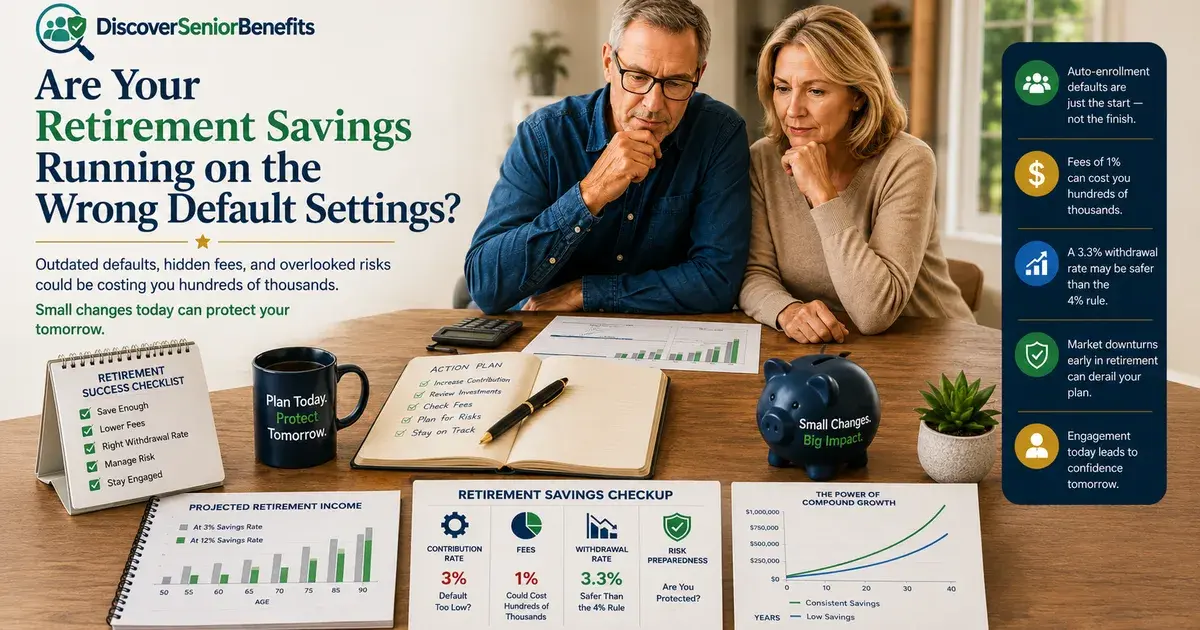
Are Your Retirement Savings Running on the Wrong Default Settings?
Millions of Americans are technically saving for retirement but still falling dangerously short — not because of income, but because of outdated defaults, hidden fees, and risks almost nobody plans for.
Key takeaways
- The median retirement account balance for Americans aged 55–64 is about $87,000 — less than two years of average household expenses.
- Auto-enrollment often defaults workers to a 3% contribution rate, far below the 12–15% savings rate experts say is needed for a secure retirement.
- Vanguard's current research suggests a safer withdrawal rate of about 3.3% — not the widely used 4% rule — which meaningfully reduces projected retirement income.
- A 1% difference in annual fund fees can cost hundreds of thousands of dollars in lost growth over a career; checking your expense ratios takes about 20 minutes.
- Sequence-of-returns risk — a market downturn in the first few years of retirement — can permanently damage a portfolio even if the market later recovers.
- Active engagement with your retirement plan is the single strongest predictor of retirement readiness, outweighing income level in real-world data.
The Retirement Savings Gap Is Bigger Than Most People Realize
The median retirement account balance for Americans between ages 55 and 64 is about $87,000 — total, not per month. That figure comes from Vanguard's analysis of actual transaction data from roughly 5 million retirement plan participants across 1,500 employer-sponsored plans. It is not a survey estimate. It is what people actually have saved.
For context, $87,000 covers less than two years of average household expenses for most retirees. And the median balance across all ages in that same dataset — including workers in their 50s — is just $35,286. Half of all savers in the data have less than that.
These numbers point to a structural problem, not just an income problem. The gap between people who actively manage their retirement savings and those who don't is larger than the gap between high earners and moderate earners when it comes to actual retirement outcomes.
The Auto-Enrollment Trap: Enrolled Is Not the Same as On Track
Auto-enrollment — the practice of automatically signing workers up for a retirement plan — has dramatically increased participation. Plans with auto-enrollment show a 93% participation rate, compared to 69% in plans without it. That is a real improvement.
But there is a catch. Auto-enrollment gets people into the plan. It does not automatically get them saving enough.
The most common default contribution rate set by auto-enrollment is 3% of pay. Some plans default to 4% or 6%, but 3% is the most frequent. Here is what 3% actually produces:
- A 40-year-old earning $80,000 contributing 3% saves $2,400 per year.
- At a 7% average annual return over 25 years, that grows to roughly $162,000 by age 65.
- Using a 4% annual withdrawal, that generates about $6,400 per year in retirement income.
- Financial industry benchmarks suggest replacing 70–80% of pre-retirement income — on $80,000, that means needing $56,000–$64,000 per year.
- $6,400 is about 11% of that target.
Vanguard's own retirement modeling assumes a savings rate of 12–15% over a full career to reach an adequate income replacement in retirement. Defaulting workers into 3% and expecting adequate outcomes is a fundamental mismatch.
The human brain tends to treat a preset number as a recommendation. When 3% is what the employer set up, it feels like the "right" amount — even when it is far from sufficient. Changing that number in your employee portal is one of the highest-impact actions available to any worker still in the accumulation phase.
The 4% Withdrawal Rule Is Being Revised Downward
For three decades, the "4% rule" has been the foundation of retirement income planning. The idea: withdraw 4% of your portfolio in year one of retirement, adjust for inflation each year, and your money should last 30 years. It was based on historical stock and bond returns going back to 1926.
Vanguard's current research places the safer withdrawal rate for a balanced portfolio at approximately 3.3% — a 17.5% reduction from the traditional 4%.
What does that mean in practice? If your retirement plan was built around withdrawing $40,000 per year from a $1 million portfolio, the updated modeling suggests $33,000 is the safer number. That is $7,000 less every year for the rest of retirement.
Two factors are driving this revision:
- Bond returns have changed. The original model was built in an era when the bond side of a balanced portfolio generated meaningful real yields. That environment has shifted significantly.
- People are living longer. The original model assumed a 30-year retirement. Many people retiring at 62 or 63 today may need their savings to last 35–40 years. Every additional year in retirement is another year the portfolio must fund without work income.
If your retirement plan still uses 4% as its withdrawal assumption, it may be time to recalculate. Confirm any updated figures with a financial professional or your plan administrator, since individual circumstances vary.
Sequence-of-Returns Risk: The Risk Almost Nobody Plans For
Consider a retiree — call him Gerald — who did nearly everything right. He started contributing to his 401(k) at 28, never missed a contribution, and steadily increased his savings rate with each raise. By age 62, he had accumulated $850,000, putting him in the top 20% of American savers.
Gerald retired at 62, planned on 4% annual withdrawals ($34,000/year), and expected Social Security to begin at 67. His spreadsheet looked clean.
In his second year of retirement, the market dropped 30%. His $850,000 fell to roughly $595,000 at the trough. He kept withdrawing — because that is what retirement savings are for. By the time the market recovered, his portfolio sat at about $540,000, not because the recovery failed, but because he had been selling depressed shares to cover living expenses throughout the downturn. Those shares were gone and could not participate in the rebound.
This is called sequence-of-returns risk. Two retirees with identical portfolios and identical withdrawal rates can end up in radically different financial positions 20 years later based solely on when they retired relative to the market cycle.
Gerald tightened spending at 64, held on, and started Social Security at 67 as planned. He is okay — but okay was not the plan. The plan was comfortable. What he got instead was two years of genuine financial anxiety with no practical way to rebuild.
Protections to consider before retiring:
- Maintain a cash reserve covering 2–3 years of living expenses so you are not forced to sell investments during a downturn.
- Use a sequence-of-returns calculator (free tools are available online) to stress-test what happens if the market drops 30% in year one or two of retirement.
- Have a written plan for reducing withdrawals in a down market.
Hidden Fees Are a Silent Tax on Your Retirement
Investment fees — called expense ratios — are expressed as small percentages and are easy to overlook. But the compounding effect of even a 1% difference in annual fees is enormous.
On a $200,000 starting balance over 30 years at a 7% gross return:
- Paying 1% in annual fees results in roughly $1,149,000 at retirement.
- Paying 0.1% in annual fees results in roughly $1,486,000 at retirement.
- That is a $337,000 difference — from a number that felt too small to matter.
Many older employer plans, particularly those set up in the early 2000s, carry expense ratios of 1%, 1.5%, or even close to 2%. Employees in those plans often never checked because no one told them to.
Vanguard's own plan data shows an average expense ratio of about 0.09% — nine basis points — reflecting decades of pushing toward low-cost index funds. But not every plan has caught up.
What to do: Log into your retirement plan account and look up the expense ratio on every fund you hold. If any fund charges more than 0.5%, look for a low-cost index fund alternative in your plan's menu — such as a total market index or S&P 500 index fund, which often carry expense ratios between 0.03% and 0.1%. This review takes about 20 minutes and can be worth six figures over a career.
Active Engagement Is the Strongest Predictor of Retirement Readiness
Vanguard's behavioral data reveals something counterintuitive: the single strongest predictor of retirement readiness is not income, not investment returns, and not savings rate measured in isolation. It is how often a person actively engages with their retirement plan.
The average plan participant reviews their account approximately once per year. Among auto-enrolled participants, a substantial share has made zero changes to their contribution rate or fund allocation since the day they enrolled.
The retirement system has been engineered to minimize effort — auto-enrollment, auto-escalation, target-date funds that rebalance automatically. These features increase participation, which is genuinely good. But the same data shows that people who engage deliberately and regularly — reviewing their account, adjusting contributions, checking fund allocations — consistently end up in better financial shape than those who let the automation run untouched.
Think of it in three levels of deliberateness:
- Level 1: Enrolled at the default rate, account not reviewed in years. Technically participating, but likely underfunded and overpaying in fees.
- Level 2: Has increased contributions at least once, has a general sense of what funds are held. Meaningfully ahead of the median.
- Level 3: Knows the current research on safe withdrawal rates, has stress-tested the first five years of retirement against a down market, knows expense ratios to two decimal places, and has a written plan for the income gap between retirement date and Social Security start date.
The gap between Level 1 and Level 3 is not a money gap. It is an attention gap — and attention is free.
Three concrete steps to take now:
- Check every expense ratio in your 401(k). Move funds above 0.5% to low-cost index equivalents.
- Recalculate your retirement target using a 3.3% withdrawal rate instead of 4%. Adjust your savings rate or timeline accordingly.
- Stress-test your first five years of retirement against a 30% market drop. Build a cash buffer of 2–3 years of expenses if needed.
Always confirm specific numbers and eligibility details with a qualified financial professional or your plan administrator, as individual situations vary.
See which of these programs you may qualify for. Free, no SSN, about five minutes.
Find my benefitsNot legal or financial advice. The agency makes the final eligibility decision.
Related articles
4 min read
TrumpIRA and the Federal Saver's Match: What Retirees Should Know
A new government website called TrumpIRA.gov is set to launch by January 1, 2027, connecting low- and middle-income workers to vetted private IRAs — and a federal matching contribution of up to $2,000 a year.
5 min read
4 Retirement Tax Surprises and How to Manage Them
Retirement taxes can be more complicated — and more costly — than many people expect. Here are four common tax surprises retirees face, plus strategies to help reduce the impact.
4 min read
Retirement Savings Options for the Self-Employed
Going self-employed doesn't mean giving up on retirement savings. Several tax-advantaged accounts — including solo 401(k)s, SEP IRAs, and HSAs — can help you build a strong financial future on your own terms.
Ask this article
Get answers about this article from the assistant on any paid plan.