· 5 min read
Can Medicaid Pay You to Care for a Family Member?
Many states run Medicaid home care programs that may pay a relative or friend to provide care at home. Here is how they work, who may qualify, and what caregivers should watch for.
Key takeaways
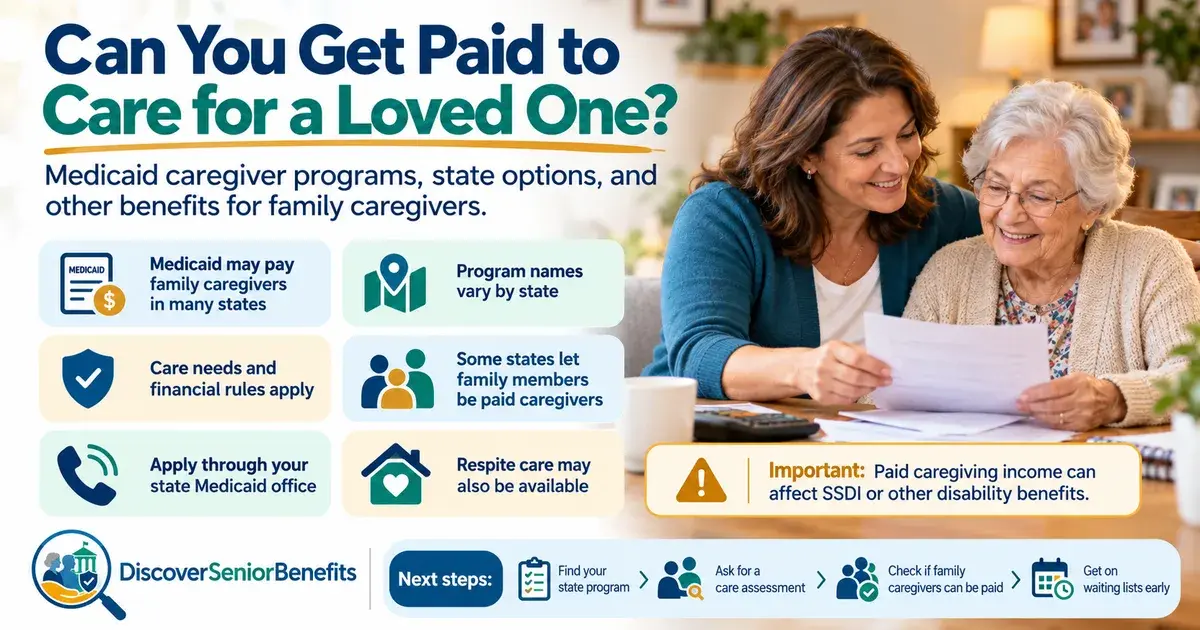
- Medicaid home care programs in many states may pay a family member or friend to care for someone at home, but rules differ by state.
- Your state may use a different name for Medicaid, and the paid-caregiver program may have its own name too, such as IHSS in California.
- Do not skip applying because income looks too high; if one spouse needs care, special spousal protections can change the math.
- Paid caregiver income can count as earned income and may affect Social Security disability benefits.
- Call your state Medicaid office early, because waiting lists can be long, and ask about respite care for caregiver breaks.
- Medicaid funding is expected to face cuts, so programs, hours, or pay could change in some states.
Want to know which programs fit your situation? A free check shows what you may qualify for in about five minutes. No SSN.
Discover my benefitsWhy states pay family caregivers
Many older and disabled people cannot care for themselves. If no one can help, the state often has to place them in a facility. That costs a lot of money. It is often not the best choice for the person either, because most people do better at home.
Some family members would gladly provide care but cannot, because they must work to pay rent, food, and bills. Many states solved this with a simple deal. The state pays the caregiver some money each month so they can stay home and provide care. It can be good for the person receiving care, good for the caregiver, and good for the state.
What Medicaid home care programs are
Medicaid is a needs-based health insurance program for people with low income and few assets. It covers older adults, people with disabilities, and children. Some states do not use the word "Medicaid." The program may go by another name, but it is the same program.
Some programs inside Medicaid have their own names:
- California calls its program IHSS (In-Home Supportive Services).
- New York calls its program CDPAP.
- Florida uses a participant direction option.
If Medicaid staff say there is nothing available, ask what the state calls its home care program. A caller may be sent to a different department, and that is normal.
A few definitions help:
- Long-term care is ongoing help with daily activities, at home or in a facility.
- A nursing home is a place to live with personal care and nursing services.
- Skilled nursing is short-term, intense therapy, often after surgery.
- Hospice is care near the end of life.
A person can have both Medicare and Medicaid. This is called being dual eligible.
Who qualifies and who can be paid
Both the person receiving care and the caregiver must meet program rules. The person must meet financial and care-need rules. The program approves the services and the number of hours of care.
Which relatives can be paid depends on the state. Some states allow children to be paid. Some allow siblings. Some do not. Some programs let the person pick a family worker, while others use a stranger.
This is not a guaranteed full-time paycheck. A care plan sets the approved care. The program then confirms the hours, the wages, and the start date.
Do not rule yourself out on income
A common mistake is looking at the income limit, seeing that a couple's Social Security adds up to too much, and not applying. Not applying guarantees a denial.
When one spouse needs facility or home care and the other spouse lives at home, spousal impoverishment protections may apply. These protections may exempt part of the at-home spouse's income so that spouse can keep paying the rent or mortgage, utilities, and property taxes. Separate asset protections apply too. The at-home spouse is treated differently from the person who needs care.
A household that looks over the limit on paper may still qualify. Apply and let the agency decide.
How caregiver pay can affect your own benefits
Caregivers who receive Social Security Disability Insurance (SSDI) need to be careful. Pay from the state for caring for a loved one is income. It counts as earned income, even if the person is a grandparent or relative. Whether it is taxed is a question for the IRS.
Some caregivers on disability receive a work continuing disability review (CDR) from the Social Security Administration because records show they are working. Overpayments can result. Rules such as the trial work period apply to people who work while on disability. Anyone in this situation should learn those rules before accepting paid caregiver work.
Steps to take now
Start with a phone call to your state Medicaid office. Questions to ask include:
- How do we request a care assessment and apply for home care?
- Does the program let an eligible family member be paid to provide care?
Write down each next step and any proof the agency asks for. Act soon. Some states have waiting lists, and they could grow longer.
Respite care is a separate kind of help. It gives caregivers a short break, such as a day or two, while someone else steps in. It may come from Medicaid, a city, a county, or the state, depending on where you live.
Expect change. Medicaid funding is expected to be cut, and states must decide how to pay for programs. Hours, pay, or eligibility lists could be affected in some places. Details vary, and the agency makes the final eligibility decision.
Caregivers: check the Medicare plan too
Caregivers often end up helping with a loved one's Medicare as well. Medicare Advantage plans are only good for one year. If nothing is done, a plan may renew with different costs and limits.
The annual enrollment period runs from October 15 to December 7, and new coverage starts January 1. Free Medicare counseling can compare plans. Have the current plan, doctors, hospitals, prescriptions, and preferred pharmacy ready. A caregiver with power of attorney, or with the person on the phone to give permission, can help.
Each person should choose a plan based on their own doctors and prescriptions, not a housemate's. Plans are local, so a plan that works well for a relative in another area may not suit you. A plan notice, called the annual notice of change, should come from the plan itself. Be careful with mail or calls from anyone else trying to sell something.
Programs in this article
- How to apply for In-Home Supportive Services (IHSS) →
- How to apply for New York Medicaid for Aged, Blind, or Disabled (Non-MAGI Medicaid) →
- How to apply for National Family Caregiver Support Program (OAA Title III-E) →
- How to apply for State Health Insurance Assistance Program (SHIP) →
- How to apply for Supplemental Security Income (SSI) →
See which of these programs you may qualify for. Free, no SSN, about five minutes.
Discover my benefitsSources
Program facts in this article trace to these official pages, the same ones the eligibility rules cite.
- In-Home Supportive Services (IHSS) · cdss.ca.gov · Last verified · October 22, 2026
- New York Medicaid for Aged, Blind, or Disabled (Non-MAGI Medicaid) · health.ny.gov · Last verified · October 20, 2026
- National Family Caregiver Support Program (OAA Title III-E) · acl.gov · Last verified · October 22, 2026
- State Health Insurance Assistance Program (SHIP) · acl.gov · Last verified · October 22, 2026
- Supplemental Security Income (SSI) · ssa.gov · Last verified · October 20, 2026
Not legal or financial advice. The agency makes the final eligibility decision.
Related articles
4 min read
Caregiver Pay and Social Security Benefits for Families
Some states pay family members to care for a loved one at home, and Social Security has benefits for caregivers, spouses, and disabled adult children. Here is what to know before you apply.
5 min read
Social Security & Medicare Penalties: How to Avoid Them
Millions of Americans pay more than they should because of Social Security and Medicare penalties they never saw coming. Here is what each penalty is, why it happens, and how to protect yourself.
5 min read
Medicare Part D Changes, Social Security Tips, and What Seniors Need to Know Now
Major shifts in Medicare Part D drug coverage and Medicare Advantage plans are coming. Here is what seniors and caregivers need to understand — and do — before open enrollment.
Ask this article
Get answers about this article from the assistant on any paid plan.