· 4 min read
Medicare Savings Programs: How to Apply and Save Money
A Medicare Savings Program may cover your monthly Part B premium. Here is how to call, apply, and keep good records without getting stuck on paperwork.
Key takeaways
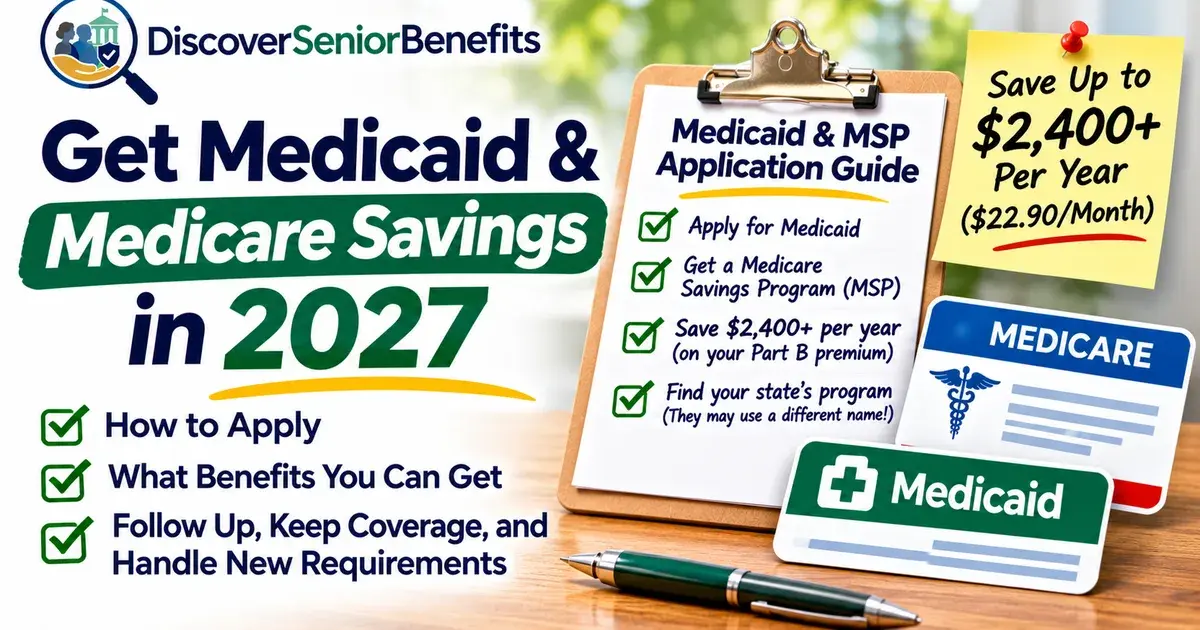
- A Medicare Savings Program may pay your Medicare Part B premium, which is $22.90 a month in the video's example.
- Call your state Medicaid office and ask them to check your Medicaid eligibility and the Medicare Savings Program together.
- Do not rule yourself out. Let the agency decide, because one car and your home are not counted as resources.
- File first and gather documents later, so you do not lose months of benefits.
- Write down who you spoke with, what they said, and set a follow-up date on your calendar.
- Approval for Medicaid can also lead to Extra Help with Medicare Part D drug costs.
Want to know which programs fit your situation? A free check shows what you may qualify for in about five minutes. No SSN.
Discover my benefitsWhy a Medicare Savings Program is worth a call
If you have Medicare, you may be paying a monthly Part B premium. The video's example is $22.90 a month. That adds up to well over $2,400 a year in savings if your state pays it for you.
The program that can do this is called the Medicare Savings Program, or MSP. It is run through your state's Medicaid office. The National Council on Aging estimates that about $58 billion in benefits goes unclaimed by people who need it. Many people never apply because the process feels confusing.
Medicaid itself can also help with other health care costs. The video covers the basic Medicaid application and the MSP. It does not cover long-term care, which is a separate topic.
Medicaid may go by a different name in your state
Many people say they do not have Medicaid in their state. Often the program just has another name. The video gives these examples:
- Louisiana: Healthy Louisiana
- Texas: STAR
- Tennessee: TennCare
- Virginia: Cardinal Care
- Minnesota: Medical Assistance
- Georgia: Georgia Families
It is all Medicaid. If you are not sure what your state calls it, start with the number the video gives for finding your office: 1-800-633-4227.
The levels of help: QMB, SLMB, and QI
There are several levels of help. The main ones named in the video are QMB, SLMB, and QI (and QDWI). They cover different things.
- QMB (Qualified Medicare Beneficiary) pays your Part B premium. It can also pay your Part A premium. Most people pay nothing for Part A. But people who did not work and pay into Medicare long enough, about 40 quarters, have to pay for it.
- SLMB (Specified Low-Income Medicare Beneficiary) is the next level up in income.
- QI (Qualifying Individual) is another level.
The video says that if you can, you want QMB or SLMB. Ask the office which application to use.
Income starting points and what counts
The video gives these starting points for a single person in 2026. Under $1,350 a month may qualify for QMB. Under $1,616 a month may qualify for SLMB. States can be a little more or less generous, so treat these as rough guides.
The agency looks at your full Social Security benefit amount. That is the amount before your Medicare premium is taken out. So if $200 of your check goes to Medicare, they still count the higher number.
Some resources do not count. One car and your first home are exempt. Some states have other exclusions too, such as a burial benefit or an ABLE account. Ask about any exclusions if you seem to be just over a limit.
How to apply: call first and do not deny yourself
Start with a phone call to your state Medicaid office. A simple script from the video: ask them to check your Medicaid eligibility, including the Medicare Savings Program. Ask which application you should use. Some staff miss the MSP part, so say it clearly.
Key tips:
- Do not deny yourself. Let the agency decide. If you are denied, you can follow up.
- File first. Do not wait to collect every document. Waiting can cost you months of benefits. The office will tell you which documents it needs.
- Expect questions. They will ask for your Social Security number, name, address, income, and resources like bank balances. The call can take about 20 minutes.
- Do not accept a run-around. If you are told you are at the wrong office, ask them to take your application anyway. If they transfer you, get the phone number first, because calls can drop.
- Ask when benefits would start. Different programs start in different months.
Some states may require you to apply online, by mail, or in person. Follow whatever your state asks.
Keep records and follow up
Write down everything. Note the date, the name of the person you spoke with, which office it was, and the phone number. Ask what happens next and how long it usually takes. Keep a copy of your application and get a confirmation receipt.
Then set a reminder on your calendar to follow up in about 15 or 30 days. Call the same person or number and ask for an update.
Extra Help and the house question
If you are approved for Medicaid, you are automatically approved for Extra Help, also called the Low-Income Subsidy. It helps with Medicare Part D prescription drug costs. The video says it can save up to $2,100 a year. You can also apply for it through Social Security, even without Medicaid.
Many people worry that applying for Medicaid means losing their home. The video explains that the concern is about long-term nursing home care. In that case, a state may seek repayment from your estate after you pass away. Some states are more aggressive than others. An estate attorney can explain options such as an irrevocable trust, which must be set up 5 years ahead. That is different from the basic Medicaid and MSP help described here.
This article is general information, not legal or financial advice. Your state agency makes the final decision on eligibility, so confirm details with them.
Programs in this article
See which of these programs you may qualify for. Free, no SSN, about five minutes.
Discover my benefitsBenefits in your area
Pick your state to see the programs that serve your county.
Sources
Program facts in this article trace to these official pages, the same ones the eligibility rules cite.
- Qualified Medicare Beneficiary (QMB) · medicare.gov · Last verified · November 23, 2026
- Specified Low-Income Medicare Beneficiary (SLMB) · medicare.gov · Last verified · November 23, 2026
- Qualifying Individual (QI) · medicare.gov · Last verified · November 23, 2026
- Extra Help (Part D Low-Income Subsidy) · ssa.gov · Last verified · November 23, 2026
- State Health Insurance Assistance Program (SHIP) · acl.gov · Last verified · November 23, 2026
Not legal or financial advice. The agency makes the final eligibility decision.
Related articles
5 min read
Social Security & Medicare Penalties: How to Avoid Them
Millions of Americans pay more than they should because of Social Security and Medicare penalties they never saw coming. Here is what each penalty is, why it happens, and how to protect yourself.
4 min read
Medicare Open Enrollment 2026: Key Dates & Cost-Saving Programs
Medicare Open Enrollment runs October 15 to December 7, 2026. Here is what to do before the deadline — and two programs that can cut costs year-round.
5 min read
4 Retirement Health Care Decisions to Get Right
Missing a health coverage enrollment window in retirement can mean higher costs that last for years. Here are the four decisions that matter most — and how to approach each one.
Ask this article
Get answers about this article from the assistant on any paid plan.